Increasing nonprofit ticket sales usually has less to do with your event and more to do with how you sell it. The venue is booked, the date is set, and sales are slower than last year. Panic discounting follows, and the event ends up raising less than it should.
The strategies below are the ones that reliably move numbers, and none of them involve cutting your price. They work because they change who is doing the selling, how early it starts, and how easy you make it to say yes.
Why Nonprofit Ticket Sales Stall
Most ticket problems come from one of three places. You started selling too late, so there was never enough runway. You relied on the organization to do the selling, rather than the people who actually know your supporters. Or the buying process asked too much of people who were ready to commit.
Pricing gets blamed far more often than it deserves. If you do want to work on price, our guide to pricing nonprofit event tickets covers models, tiers and the break-even formula. Everything below assumes your price is roughly right.
7 Strategies to Increase Nonprofit Ticket Sales
Work through these in order. The first three change your ceiling. The last four help you reach it.
1. Start Selling Earlier Than Feels Comfortable
Most nonprofits open sales when everything is ready: the speaker confirmed, the menu set, the graphics designed. By then you have lost weeks of selling time you cannot get back.
You do not need a finished event to take a booking. A date, a venue, a price and a cause are enough for the people closest to you, and those early sales give you a real number to build the rest of the plan around.
Open sales the day the venue is confirmed. Add the detail as it lands.
2. Sell Tables and Groups, Not Just Seats
This is the single biggest lever for most fundraising events, and it is routinely underused. One conversation that sells a table of ten does the work of ten conversations that sell single seats.
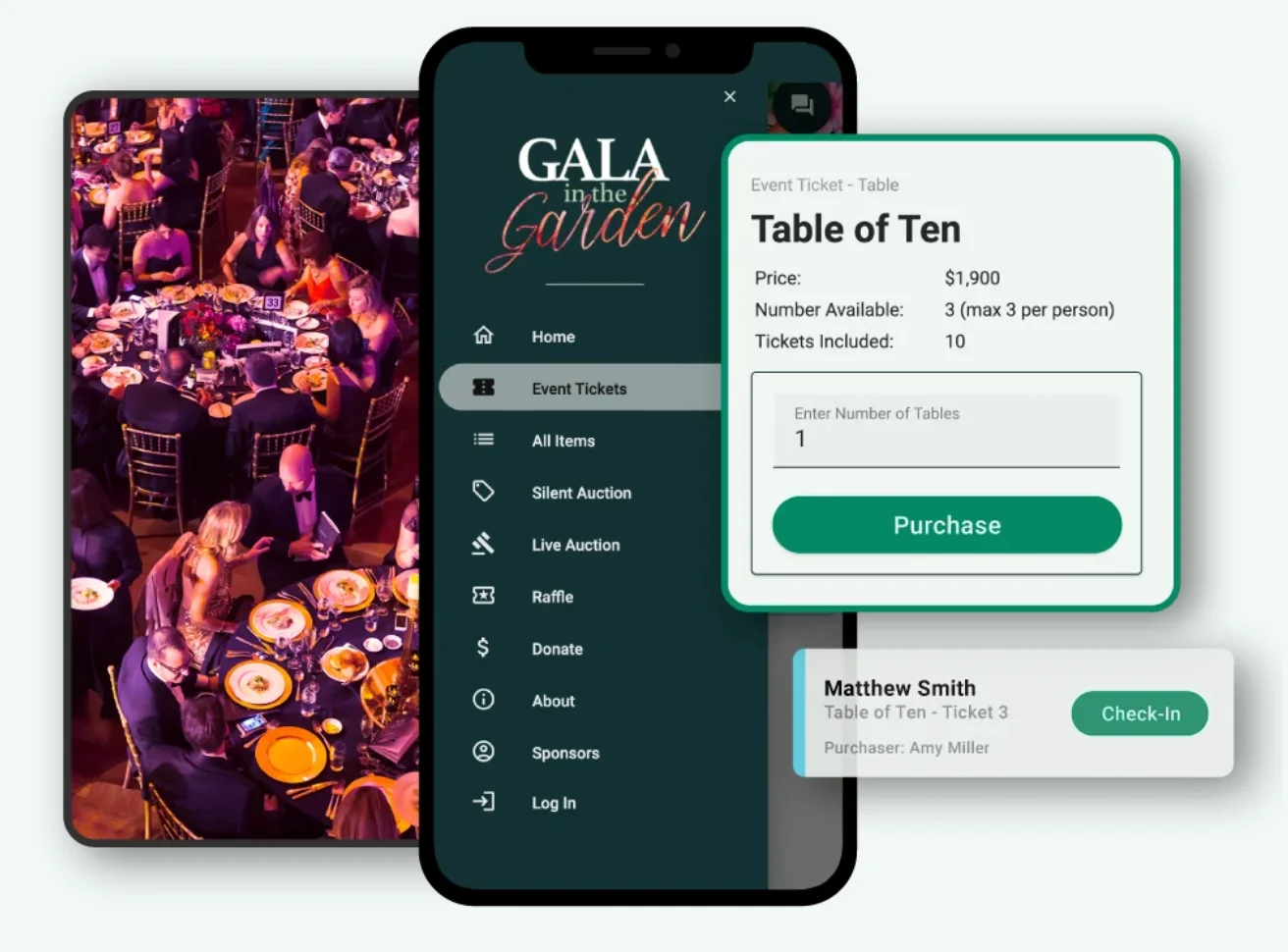
Make the table the headline option rather than an afterthought at the bottom of the page. Give it a name, a price and a clear description of what a table buyer gets, then let individual seats be the fallback for people who cannot fill one.
The practical side of this matters too. If you sell tables you need a way to collect the guests attached to each one, which is where table management comes in.
3. Put Your Committee and Board to Work
Your organization has a reach problem. Your committee members do not. A personal message from someone a supporter knows outperforms anything you send from a shared inbox.
Give every committee and board member a specific, small, countable target. Two tables each is a real ask. "Help promote the event" is not, and it produces nothing.
Give them something to send, too. A shareable link they can drop into a text message or an email removes the excuse that they did not know what to say.
4. Cut the Friction Out of Checkout
Every extra step between wanting a ticket and having one costs you sales. Long forms, forced account creation and a checkout that fights a phone screen all take a toll.
Mobile matters more than most nonprofits plan for. In 2025, 43% of online donations were made on a mobile device, and a ticket checkout that only works properly on a laptop is quietly turning people away.
Ask only for what you need at the point of sale. Anything else, such as meal choices or guest names, can be collected afterwards without holding up the payment.
5. Build Deadlines Into Your Ticket Types
People do not buy tickets because they are cheap. They buy because something is about to close. A price that steps up on a published date gives them a reason to act today rather than think about it.
The same works without a discount. A table release that closes, a limited allocation, or a seating plan that gets finalized on a set date all create the same decision point.
Whatever the deadline is, publish it, hold it, and tell people it is coming twice before it passes.
6. Email Your Existing List Properly
Your list already contains almost everyone who will come. The problem is rarely reach, it is that a single announcement email is treated as a campaign.
Nonprofits sent an average of 50 email messages per subscriber in 2025, so one message about your event competes with roughly 49 others. It also works: email-sourced revenue reached $2.40 per subscriber that year, up from $1.87.
Segment rather than blast. Past attendees, table buyers and lapsed supporters each need a different message, and past attendees are the warmest list you own.
7. Turn Ticket Buyers Into Sellers
The moment someone buys a ticket is the moment they are most likely to tell someone else. Almost nobody uses that moment.
Put a shareable link on the confirmation page and in the confirmation email, with a line that makes the ask directly: who else should be at your table? A buyer forwarding a link to four friends costs you nothing and reaches people your list does not.
This compounds. Every new buyer becomes another potential promoter, which is why it works better the earlier in the cycle you set it up.
Which Strategy to Use First
If you cannot do all seven, start with the one that matches the problem you actually have.
Match the strategy to the problem
Mistakes That Undo the Work
A few habits reliably cancel out everything above. Discounting early trains supporters to wait for the discount, and it is very hard to reverse once they learn it.
Extending a deadline you published does the same damage to your next event, because the deadline stops meaning anything. Hold it even when it is uncomfortable.
And do not let the sales push end at the door. A slow, disorganized arrival is what people remember when they decide about next year, so the check-in experience is part of your ticket strategy whether you treat it that way or not.
How GalaBid Helps
Several of these strategies need the software to cooperate. Table Sales and Guest Management covers strategy 2, so a supporter can buy a table and the guests attached to it get invited and tracked individually rather than sitting behind one transaction.
Multiple Ticket Types and capacity management on both the event and each ticket type give you the release dates and limited allocations that strategy 5 depends on. Shareable Links give your committee and your buyers something to send, which covers strategies 3 and 7.
Checkout runs on Secure Payment through Stripe, with Custom Registration Fields you can keep short at the point of sale and use later for the details you need. You can run nonprofit ticketing on its own or connect it to your wider fundraising event activity.
Frequently Asked Questions
How far in advance should you start selling event tickets?
Open sales as soon as the date and venue are confirmed, which for most galas is three to four months out. You do not need the full program in place to take a booking. Early sales also give you a demand signal while you still have time to act on it.
Should nonprofits discount tickets to boost sales?
Rarely, and almost never once sales have opened at full price. Discounting late teaches supporters to wait, which costs you more next year than it gains you this year. A published deadline or a limited release creates the same urgency without lowering what you raise.
What is the fastest way to sell more tickets to a fundraising event?
Personal asks from committee and board members, aimed at tables rather than single seats. One conversation that sells a table of ten does the work of ten separate sales. Give each person a specific target and something they can forward.
Why do people visit the ticket page and not buy?
Usually friction rather than price. Long forms, forced account creation and a checkout that does not work well on a phone are the common causes. Ask for the minimum at the point of sale and collect the rest afterwards.
How many emails should you send about an event?
More than one, and to different segments. Past attendees, table buyers and lapsed supporters each need a different message. A single announcement to the whole list is the most common reason a large list produces few sales.
In Summary
Ticket sales respond to runway, personal asks and a buying process that gets out of the way. Start earlier, sell tables rather than seats, and get the people who know your supporters doing the asking.
Then remove the friction, publish a deadline you will actually hold, work your list in segments, and let your buyers do some of the selling for you. If sales are slow right now, start with strategies 3 and 5. If you have time before the next event, start with 1 and 2.
More articles about Ticketing & Check-in for Fundraising Events
About GalaBid
Ideal for donations. Perfect for Raffles. Awesome for Live and Silent Auctions! GalaBid’s online fundraising platform is designed for fundraisers of all types and sizes. For over 10 years we’ve been helping non-profits, charities, community clubs, churches, schools, and individuals to raise more and make a difference.