If you are running a gala, a race day or a school fundraising night in Australia, the ticketing platform you choose decides two things that matter more than the headline fee: how much of each ticket you keep, and when you actually get the funds.
Most Australian ticketing platforms hold your ticket revenue until after the event has finished. That is standard practice and it protects the platform against refunds. It also means the deposit for your venue, your caterer and your auctioneer comes out of your own reserves first.
This comparison covers seven platforms Australian charities and not-for-profits actually use, with published fees, fund custody, payout timing and what each one does beyond selling admission. Every figure was checked in September 2026 against each platform's own Australian pricing.
Quick Comparison of Australian Charity Ticketing Platforms
What Australian Charities Should Check Before They Choose
The four questions below separate these platforms far more than the fee percentages do. Work through them before you compare rates.
Who Holds Your Funds Between the Sale and the Event
Six of the seven platforms here hold your ticket revenue until after your event. Humanitix releases within five business days of the event ending. Eventbrite pays three days after the end date and holds back 20% of net sales as a refund reserve on any rolling schedule. Sticky Tickets waits until you log in and mark the event complete.
TryBooking is the most restrictive of the group. It publishes no payout timeline at all, asks you to submit a transfer request, and warns that requests made before the event can trigger identity and event verification taking up to seven days.
GalaBid is the exception. Funds move from Stripe to your own bank account and never pass through GalaBid, so you set the payout schedule yourself. If you are paying suppliers in the weeks before the event, that difference is worth more than a fraction of a percent on the fee. You can read how GalaBid handles payments and funds safety in full.
How the Fee Is Structured, Not Just How Big It Looks
Percentage fees and flat per ticket fees behave very differently depending on what you charge. On a $30 community event ticket, a percentage model is cheap. On a $250 gala seat, the same percentage becomes the largest single line item on your ticketing costs.
Australian charity gala tickets typically sit between $100 and $250 a seat, and tables of ten push the order value higher again. That is exactly where flat per ticket pricing pulls ahead, which is why GalaBid quotes a flat fee per ticket in Australia rather than a share of the ticket price. Our guide to pricing event tickets for maximum revenue works through the maths.
Here is what one $150 gala seat costs on each platform, using published Australian rates as at September 2026:
- GalaBid: $2.50 excluding GST, plus Stripe's fee paid directly by your organisation
- Humanitix, charity rate: $4.25 excluding GST, or $6.99 on the standard rate
- TryBooking: $4.25 across organiser and buyer combined, GST treatment not stated
- Sticky Tickets: $4.50 including GST
- Ticketebo: $6.00 including GST on a single ticket order, less per head if the order covers several seats
- Eventbrite: $9.22, GST treatment not stated
Read those as structural rather than exact. GST treatment varies and some platforms split the cost between organiser and buyer, so confirm the current position with each provider. Across a 300 seat gala, though, the gap between the cheapest and the dearest option on this list runs to roughly $2,000.
Ticketebo is worth a second look here for a different reason. Its 4% is charged per order rather than per ticket, so a family or a syndicate buying four tickets in one transaction pays once. For events where people book in groups, that structure can beat per ticket competitors outright.
Whether the Platform Does Anything Beyond Tickets
This is the sharpest divide in the table. None of the six ticketing specialists offer a silent auction, a live auction or paddle raise. Sticky Tickets sells raffle tickets. Humanitix, TryBooking and Eventbrite handle donations alongside admission. That is the extent of it.
For a straight ticketed event, that is fine. For a fundraising gala, it means running your silent auction, raffle and paddle raise on a second system, then reconciling two guest lists and two payment flows afterwards. GalaBid combines ticketing and check-in with auctions, raffles and donations in one campaign.
Why One Login Across the Whole Event Matters
When ticketing and fundraising sit in the same system, your supporter registers once, at the point they buy their ticket. Their card is stored securely at that moment. By the time they walk in, they are already able to bid, buy raffle tickets and give, with nothing further to set up and no app to download.
That removes the single biggest source of friction on the night. Every minute an attendee spends creating a second account for the auction is a minute they are not bidding, and the people who never finish that second signup are the ones you lose entirely.
It also changes your admin afterwards. One record per supporter covers their ticket, their bids, their raffle entries and their donations, so there is one checkout at the end of the night and one report the next morning instead of two systems to reconcile by hand.
Where the Support Team Actually Sits
Event nights fall outside business hours, and they do not reschedule. Humanitix, TryBooking, Ticketebo, Sticky Tickets and Megatix are all Australian founded. Eventbrite is a United States company offering round the clock chat on paid events, but no Australian phone line that we could find.
GalaBid runs support by phone, live chat and email from Australian offices, and offers on-site technical support delivered by Sydney based staff if you want people in the room on the night.
The Seven Platforms Compared
1. GalaBid
GalaBid is a fundraising platform with ticketing built in, rather than a ticketing platform with a donation button added. It has operated from Sydney since 2011 and works with Australian organisations including Taronga Zoo, Bravehearts and Support Act.
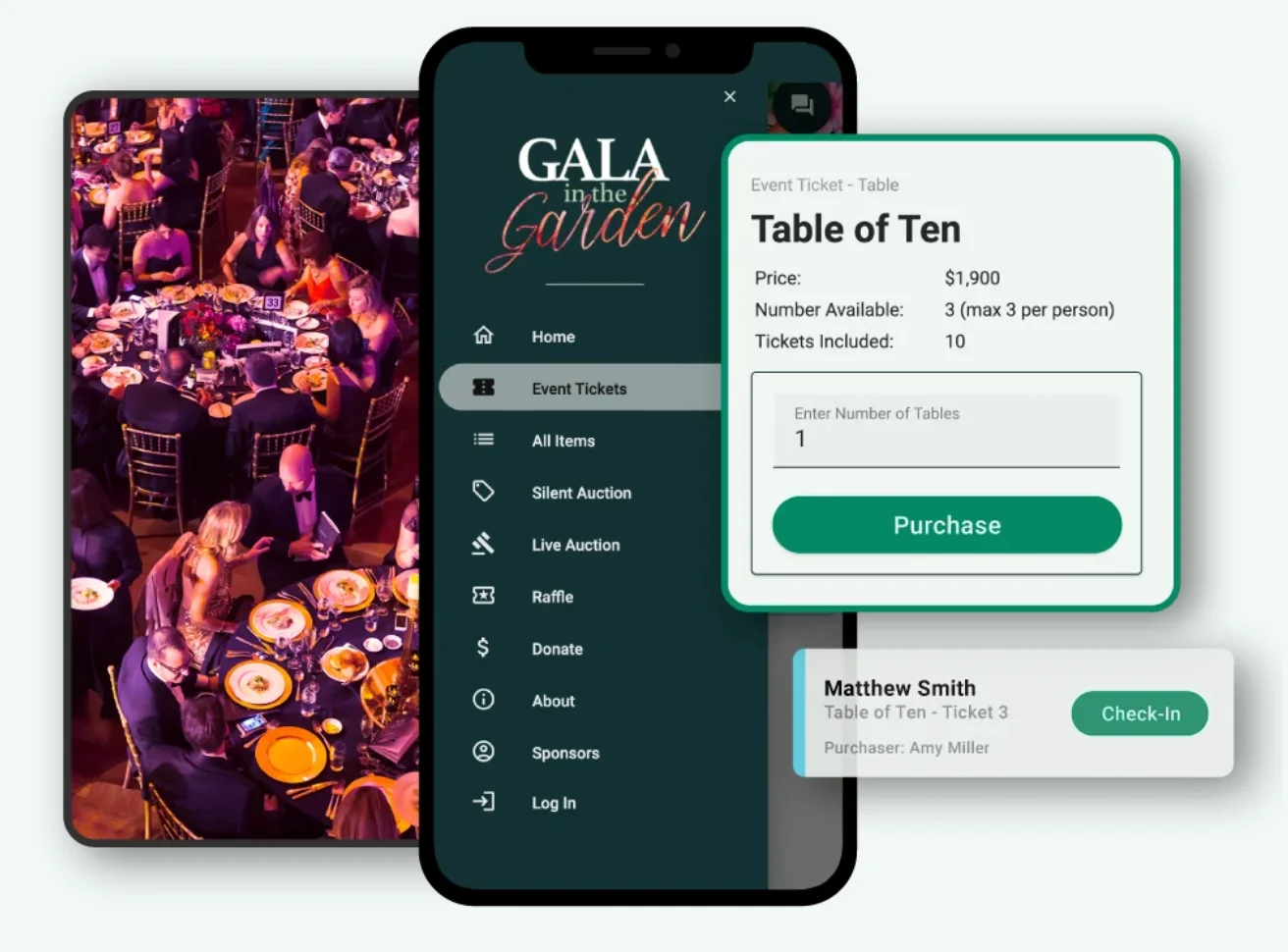
Ticketing covers multiple ticket types, individual and table sales, and lets a table purchaser allocate their own seats and invite their guest list. You can attach custom questions for dietary requirements or accessibility needs. Check-in is handled by staff or volunteers marking attendees off through the dashboard or a volunteer account.
Fees. GalaBid does not publish Australian ticketing pricing, because it is quoted per campaign alongside whatever else you are running. The typical rate is $2.50 per ticket excluding GST, charged as a flat fee rather than a percentage of the ticket price. You connect your own Stripe account and pay Stripe's fees directly, with no mark up from GalaBid. Request a quote for your event.
Best for. Galas, balls and race days where ticketing sits alongside an auction, a raffle or a paddle raise, and organisations that want their funds arriving before the event rather than after it.
Worth knowing. Table and seat planning, and QR scanning at check-in, are both listed as coming soon. If a visual seating chart is a hard requirement for your event this year, ask about it before you commit.
2. Humanitix
Humanitix is the strongest option here for organisations that only need tickets. It is a Sydney based registered charity with no shareholders, and it directs 100% of the profits from its booking fees to partner charity programs. Note the wording: that is profits after costs, not the full fee.
Standard pricing is 4% + $0.99 per paid ticket excluding GST. Registered charities, not-for-profits and schools can apply for a rate of 2.5% + $0.50. The discount is not automatic. You email from an organisational address with evidence of your registration, and it is reviewed per account.
Funds are held until after the event and paid within five business days, unless you connect your own Stripe account, which removes the hold. There is no auction, raffle or paddle raise functionality.
Best for. Ticket-only events run by organisations that like the idea of their booking fees funding other charitable work.
3. TryBooking
TryBooking is Australian owned and heavily used by schools, community groups and sporting clubs. It charges $0.50 per ticket to the buyer, dropping to $0.15 on tickets of $5 or less, plus 2.5% processing to the organiser. Credit card costs are included in that.
It is unusually flexible about who pays. You can pass the processing fee to the buyer as well, or absorb both. It also applies the same rates to everyone, stating plainly that not-for-profit status makes no difference. There is nothing to apply for, but there is nothing to gain either.
The trade-off is access to funds. TryBooking publishes no payout timeline, holds the revenue, requires you to request a transfer, and recommends waiting until the event is over.
Best for. Schools and clubs running frequent low value events, where the $0.15 rate on cheap tickets is hard to beat. See our notes on school fundraising and club fundraising.
4. Eventbrite
Eventbrite is the default that most committees suggest first, and the most expensive on this list for Australian charities at 5.35% + $1.19 per paid ticket. There is no charity or not-for-profit rate. Donation ticket types are charged at 2%.
What you get for it is reach. Eventbrite has a public discovery marketplace, which none of the Australian specialists match, so it can put your event in front of people who have never heard of your organisation. For a first-year public event that can be worth the premium.
Payouts default to three days after the event ends. Rolling schedules are available to organisers who have run a paid event before, with 20% of net sales withheld as a reserve. We cover the alternatives in more depth in our guide to Eventbrite alternatives for fundraisers.
Best for. Public events that need discovery, where reaching a new audience outweighs the fee.
5. Ticketebo
Ticketebo charges 4% including GST of the order value with a $1.20 minimum, and the fee applies per order rather than per ticket. For events where people book in groups that structure works out cheaper than the per ticket alternatives. There is no card surcharge.
It is Australian owned with support available seven days a week on an Australian number, and it rebates 10% of booking fees to registered charities. Funds are held until after the event, with a sales report on the Monday following and payment the next business day, unless you route payments through your own Stripe account.
Its Trustpilot standing is the strongest of the specialists at 4.9 from 981 reviews.
Best for. Events with high group and family booking rates, where per order pricing beats per ticket pricing.
6. Sticky Tickets
Sticky Tickets has operated in Australia since 2007 and prices in tiers that include GST, from $1.00 on tickets under $10 through to $4.50 on tickets between $100 and $149.99. Tickets of $150 and above are charged $1.50 plus 2%. Group purchases attract a 10% reduction.
It is the only platform here besides GalaBid that sells raffle tickets natively, and ATO registered charities receive 10% of credit card booking fees back. There is no silent auction function in the platform itself.
Funds are released only after you log in and mark the event as complete, then take one to three days. Early access is capped at 50% of revenue and costs a $49 processing fee plus identity documents.
Best for. Community events at the lower ticket price tiers, particularly where a raffle runs alongside.
7. Megatix
Megatix is Australian founded and operates across the Asia Pacific, but it is built for festivals, venues and tourism rather than fundraising. It publishes no pricing, no payout terms and no fund holding policy, and offers no donation, raffle or auction tools. Pricing is quoted on request.
Its Trustpilot rating is 2.5 from 8 reviews, which is too small a sample to draw much from, but it is the only public signal available.
Best for. Ticketed music and festival events rather than charity fundraising.
Which Platform Suits Your Event
There is no single answer, so match the platform to the shape of your event.
- Gala, ball or race day with an auction or raffle. Choose a fundraising platform rather than a ticketing platform, so admission, bidding and giving sit in one system and one guest list.
- Ticket-only event, tickets under $50. Percentage based pricing works in your favour. TryBooking and Humanitix are both strong.
- Ticket-only event, tickets over $100. Flat per ticket pricing keeps more in your account. Compare the flat fee options carefully against the percentages.
- Lots of family and group bookings. Ticketebo's per order model is worth modelling against per ticket rivals.
- You need cash flow before the event. Either use a platform that pays into your own Stripe account, or budget to cover supplier deposits yourself.
- You need a new audience. Eventbrite's marketplace is the only real discovery channel on this list.
GST, Charity Rates and Compliance in Australia
Fee comparisons get slippery because platforms quote GST differently. Humanitix quotes its standard rate excluding GST. Ticketebo and Sticky Tickets quote including GST. TryBooking and Eventbrite do not state their treatment on their Australian pricing pages at all. GalaBid quotes excluding GST. Ask each provider to confirm in writing before you compare rates side by side.
Charity rates also require proof. Humanitix asks for government charity registration or equivalent documentation, and Sticky Tickets requires ATO registered charity status. If you are unsure of your organisation's standing, the ACNC Charity Register is the place to check, and the ATO's guidance on GST for not-for-profits covers how GST applies to charitable organisations.
If you are adding a raffle to your event, permit thresholds vary by state and territory, from $2,500 in the ACT to $50,000 in Queensland. Our state by state guide to Australian raffle rules sets out where each line falls.
One more cost to model: if you connect your own Stripe account, Stripe's Australian processing fees apply on top of any platform fee. Some organisations ask supporters to cover these at checkout, others absorb them.
Frequently Asked Questions
Do Australian Charities Get Discounted Ticketing Fees?
Some platforms offer a reduced rate, but none of them apply it automatically. Humanitix offers registered charities, not-for-profits and schools 2.5% + $0.50 per ticket on application with evidence of registration. Ticketebo and Sticky Tickets rebate 10% of booking fees to registered charities instead of discounting. TryBooking and Eventbrite offer no charity rate at all.
Who Holds Ticket Funds Before the Event?
On most platforms, the platform does. Humanitix, TryBooking, Eventbrite, Ticketebo and Sticky Tickets all hold ticket revenue until after the event as protection against refunds and chargebacks. GalaBid is the exception, with funds moving from Stripe straight to your bank account on your own schedule. Humanitix and Ticketebo also release the hold if you connect your own Stripe account.
Can I Pass Ticketing Fees On to Attendees?
Yes, on every platform here that publishes its terms. Humanitix, Eventbrite and Ticketebo pass fees to the buyer by default and let you absorb them instead. TryBooking splits the two by default, with the buyer paying the ticket fee and the organiser paying processing, and lets you shift either way. Passing fees on protects your margin, though it does raise the price displayed at checkout.
What Is the Cheapest Ticketing Platform for an Australian Charity Gala?
It depends almost entirely on your ticket price. Percentage based fees are cheapest on low value tickets and become the most expensive option as the ticket price rises, which is why they suit community events more than galas. At typical gala prices of $100 to $250 a seat, a flat per ticket fee keeps more of each sale. Model both structures against your actual ticket price before deciding.
Can I Run a Silent Auction Through My Ticketing Platform?
Not on any of the ticketing specialists in this comparison. None of Humanitix, TryBooking, Eventbrite, Ticketebo, Sticky Tickets or Megatix offers silent auction, live auction or paddle raise functionality. Sticky Tickets sells raffle tickets, and Humanitix, TryBooking and Eventbrite accept donations. To run tickets and an auction together you need a fundraising platform such as GalaBid, where ticket buyers are registered to bid as soon as they book.
Choosing With Confidence
For a straightforward ticketed event, Australia has several capable local platforms and the differences come down to fee structure and how quickly you see the funds. For a fundraising event with an auction, a raffle or a paddle raise, the ticketing decision is really a platform decision, because splitting admission from giving costs you a guest list, a reconciliation and usually some revenue too.
If you want to see how ticketing works alongside auctions and donations in one campaign, ask us for a quote or take a look at what other Australian fundraisers have raised.
More articles about Ticketing & Check-in for Fundraising Events
About GalaBid
Ideal for donations. Perfect for Raffles. Awesome for Live and Silent Auctions! GalaBid’s online fundraising platform is designed for fundraisers of all types and sizes. For over 10 years we’ve been helping non-profits, charities, community clubs, churches, schools, and individuals to raise more and make a difference.