Most refund trouble at a fundraising event isn't really about refunds. It's about a policy nobody settled before tickets went on sale.
A nonprofit event ticket refund policy is the short set of rules for who gets funds back, by when, and what happens if the event doesn't go ahead. Shown in full before payment, it heads off most disputes.
Left vague, every awkward request becomes a judgment call, and your team gives different answers to different people.
This guide covers the three models nonprofits use, wording you can adapt, and what to do when an event is canceled. It also covers what generic ticketing advice skips: how a refund affects the receipt you issued.
What a Refund Policy Has to Do for a Nonprofit
A refund policy does more than decide who gets funds back. It sets expectations, sets the contract terms of the sale, gives you evidence in a card dispute, and makes your revenue forecast believable.
The contract point is the one most teams miss. Your published terms are what the ticket sale is made under, so if they say nothing about refunds, you have no agreed position to stand on.
The dispute-evidence job has a condition attached. Stripe's dispute prevention guidance warns that a checkout checkbox containing only a link to your terms may be rejected as unsatisfactory evidence. So show the full policy text on the page.
There's a nonprofit-specific reason to be exact. A ticket is exchange revenue rather than a straight gift, so a refund reverses a transaction you may already have acknowledged in writing.
If you're still setting prices and tiers, our guide to pricing and selling gala tickets covers the commercial side.
Three Core Refund Policy Models for Nonprofit Event Tickets
Almost every workable policy is one of three models. Pick one, write it down, and apply it to everyone.
Model 1: Full Refund Before a Set Date
One deadline, one rule: a full refund if the supporter asks before the date, none after it.
Set that date from your own commitment dates, meaning the day your caterer locks numbers and the day the venue bills you. Don't copy a default from a booking tool.
Say the reason. Supporters accept a caterer's deadline more readily than an arbitrary cutoff.
Model 2: Tiered Refund (Percentage-Based)
A tiered policy refunds less as the event gets closer: 100 percent at three weeks or more, 50 percent between one and three weeks, and nothing inside the final week.
Model 3: No Refund, With Named Exceptions
Tickets are non-refundable, exceptions are limited to documented emergencies, and the ticket can be transferred at any time. It's the clearest boundary, and where most galas land.
Be careful with the language. A ticket price is not a donation: it's a quid pro quo contribution, so only the amount above the fair market value of what the buyer receives is deductible.
Above $75, IRS guidance on quid pro quo contributions requires a written disclosure stating that limit plus a good-faith estimate of that value.
A no-refund policy doesn't stop a chargeback either. Supporters can still dispute the charge, and Stripe's guidance recommends refunding in reasonable circumstances because it makes a dispute less likely.
It protects ticket revenue less the processing fees, which Stripe confirms are not returned on a refund. Model 3 is a revenue-protection choice with a dispute cost attached, not a guarantee.
The Refund Policy Communication Strategy
A refund policy only works where supporters see it before they pay.
- Show the full policy text at checkout, before payment, not a link.
- Include it in full in the ticket confirmation email.
- Add it to the event page FAQ, where people look before buying.
- Repeat the deadline in your reminder emails.
- Write it in plain language. If it reads like a contract, it won't be read.
- State plainly whether any booking or processing fee is refundable.
That last point carries legal weight in the US. The FTC Rule on Unfair or Deceptive Fees, in force since May 12, 2025, covers live-event tickets and requires a seller that conveys fee information to be truthful about it, including whether the fee is refundable.
Keep the fee language factual. Processing fees apply on every plan and are not returned when you refund, so say so. For platform costs, point supporters to pricing for your region.
[VERIFY: confirm what an organizer can display on the GalaBid checkout page. No dedicated refund policy field or terms tickbox is documented; the closest option is the ticket description.]
Sample Checkout Wording
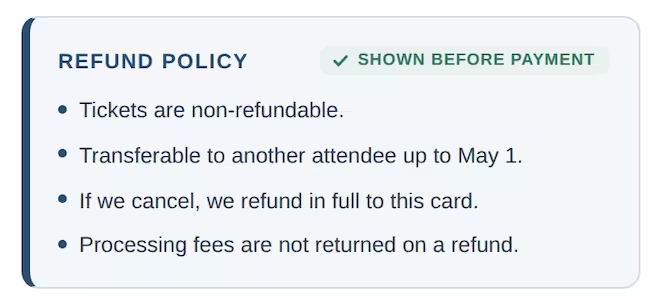
Refund policy. Tickets are non-refundable. If you can't attend, you can transfer your ticket to someone else at any time up to [date] by replying to your confirmation email.
If we cancel, we'll refund your ticket price in full to the card you paid with, within [number] days. Processing fees are not returned. Your ticket price includes $[value] toward your meal and entertainment, and only the amount above that is deductible.
Sample Confirmation Email Wording
Thank you for supporting [event name]. Your ticket is attached.
A reminder of our refund policy: tickets are non-refundable, but they are transferable. If your plans change, reply with a name and address and we'll move it across. If we cancel, you'll receive a full refund to the card you paid with.
Refund Requests Examples
Six requests account for nearly everything your team will see. Decide now which earn an exception, then write one line you're happy to send every time.
The last request is where good intentions meet the tax code. Under IRS Publication 526, a buyer can deduct the full amount only if the ticket is returned to the organization for resale. Not turning up is not enough.
Transfers do the heavy lifting elsewhere. On GalaBid you transfer a ticket from Ticket Purchases in the Ticketing and Check-In module, then enter the new attendee's details. [VERIFY steps with product.]
One caution on table sales. Refunding a table cancels every ticket in it, so check who else holds a seat.
Event Cancellation: What You Must Do
If you cancel, your obligation to refund comes from three places: your own published terms, your state law, and the buyer's card network dispute rights. There is no single federal rule.
State law can be specific. California Business and Professions Code section 22507 requires a canceled event's ticket price to be refunded within 30 calendar days. That is one state, not a national standard.
Refund duties vary by state and this isn't legal advice. Check your own requirements with counsel before publishing terms.
- If you cancel outright: email every ticket holder the same day, state the amount, method and timing, and refund to the original payment method.
- If you reschedule: offer a straight choice, keep the ticket or take a refund. Give a reply-by date and say what happens if nobody replies.
- If an emergency hits: communicate immediately, even before you know the answer. Silence turns a cancellation into a chargeback.
- If part of the event is cut: decide whether the ticket still delivers what you sold, and refund the difference if not.
- If you move online: tell ticket holders before you switch and offer a refund. The fair market value changes, so the deductible portion does too.
Building Refunds Into Your Event Budget
Build your refund baseline from your own past events. No credible published refund rate for nonprofit events exists, so your own history is the only number worth planning against.
Pull three years of ticket sales. Count refunds as a share of tickets sold, then of ticket revenue. Those diverge when higher-priced tables cancel, and the second is what your forecast needs.
Then work the fees in. Sell 200 tickets at $150 and you have $30,000 gross. Ten refunds returns $1,500, and the fees on those ten transactions stay gone.
Keep a refund and a no-show apart. A no-show has already paid, so you keep the revenue and lose only the meal. A refund costs the revenue and the fee.
Communicating Refund Denials Professionally
A denial that lands well gives the reason, offers an alternative, and doesn't sound defensive. Say no once, then move to what you can do.
- Give the reason in one sentence. Committed catering and venue costs are a reason anyone understands.
- Offer the alternatives you have: transfer the ticket, treat the amount as a gift, or come next year.
- Log the request and the decision. It is your consistency check and your dispute evidence.
Sample Denial Email: Request After the Deadline
Hi [name], thank you for letting me know, and I am sorry you cannot join us. Our refund deadline was [date], which is when we confirm final numbers with the caterer.
What I can do is transfer your place to someone else, right up to the day before. Send me a name and email address and it takes a minute.
Sample Denial Email: No-Refund Policy
Hi [name], thank you for reaching out. Our tickets are non-refundable, because we commit to the venue and catering well before the event, and that is set out in the ticket terms.
Your ticket is transferable though, so you are welcome to pass it to a friend or colleague. If you would rather it stood as a gift to [cause], I will send you an acknowledgment for the deductible portion.
Refund Policy Mistakes That Cost Trust
Six mistakes account for most of the damage, and each is a process problem rather than a wording problem.
Refund Policy by Event Type
Match the model to how much of your cost is committed before the doors open.
Raffles sit outside this article. Raffle tickets are not deductible at all under IRS Publication 526, and raffles are regulated state by state as charitable gaming.
What This Looks Like in Practice
Dudes for Dads is a US nonprofit working in the Washington DC, New York, Miami and Ann Arbor areas, supporting children who grew up without a father.
Its annual New York gala draws 400 to 500 people, with a silent auction and raffle on GalaBid. The decision worth borrowing is about fees, after an add-on charge on tickets sold elsewhere bothered the team.
"We didn’t want to have, like, the added-on fee, or, like, have people be confused of, like, oh, I clicked this amount, but then I’m seeing this amount being charged." Christian Cleaveland, Dudes for Dads
That is the communication principle in one sentence. Whatever supporters pay, and whatever comes back on a refund, should be visible before they press pay.
The team also moved from pen and paper to GalaBid, raised nearly twice as much as the year before, and got every winner their item inside a week.
More GalaBid reviews and testimonials.
Frequently Asked Questions
Why Do Refunds Have to Go Back to the Original Payment Method?
Because it is a rule rather than a choice. Stripe states that refunds can only be sent back to the original payment method used in a charge, and not to a different card or bank account.
The exceptions are narrow and handled by the bank. On an expired card, the issuer usually credits the replacement.
What Counts as a Legitimate Emergency?
Whatever you decide, written down before the first request arrives. Most nonprofits settle on serious illness, a bereavement, or a genuine travel failure, evidenced by a forwarded email.
The point is not to police it, but to make sure everyone who asks gets the same answer.
Can We Offer Credit Instead of a Refund?
Only if the supporter chooses it. Where state law requires a refund for a canceled event, credit is not a lawful substitute: the New York Attorney General secured $4.4 million in refunds from ticket sellers that moved to credit-only policies.
An issued credit can also become a regulated gift certificate in its own right. Offer it as an option, and honor a refund request.
Should Sponsors and Major Supporters Get Special Refund Treatment?
Not on tickets. One published policy applied to everyone is what protects you, and an exception for your largest supporter is the one others will hear about.
Sponsorship agreements are separate contracts, and that is where flexibility belongs.
What if Someone Says They Never Received the Confirmation With the Refund Policy?
Send it again, and do not make it the argument. This is why the full policy belongs on the checkout page as well as in the email.
Your evidence is that it was shown before payment, not that an email arrived. Keep a checkout screenshot with your send log.
How Long Should We Keep Refund Request Records?
Three years at minimum. That covers the limitations period for exempt organization filings, per the IRS compliance guide for public charities.
It also covers card network dispute windows, which for a service not received can extend well beyond a year from the transaction date. [VERIFY: exact windows if day counts are published.]
Is a Fundraising Event Ticket Tax-Deductible?
Only partly. The deductible amount is what the buyer paid above the fair market value of what they received, so a $200 ticket to a dinner worth $75 leaves $125.
Above $75 you must provide a written disclosure stating that limit plus a good-faith estimate of the value. At $250 or more the buyer also needs a contemporaneous written acknowledgment, both set out in IRS Publication 1771.
Set the fair market value with your finance team, not with any platform.
Start With the Wording
Pick one of the three models, adapt the sample wording above, and show it in full before payment. That is most of the work, and it takes an afternoon.
Setting up ticketing for your next event? GalaBid's ticketing and check-in handles single and table tickets, transfers and refunds, with real people on live chat. Funds go straight to your own account, and you can see pricing for your region.
Still comparing? Our guide to questions to ask when choosing a ticketing platform is a good place to start.
More articles about Ticketing & Check-in for Fundraising Events
About GalaBid
Ideal for donations. Perfect for Raffles. Awesome for Live and Silent Auctions! GalaBid’s online fundraising platform is designed for fundraisers of all types and sizes. For over 10 years we’ve been helping non-profits, charities, community clubs, churches, schools, and individuals to raise more and make a difference.