A raffle is one of the lowest-cost, highest-return fundraisers a small organization can run. Check the raffle rules for your region first, source a few good prizes (or run a 50/50 cash draw), price tickets at roughly 5 to 15% of the prize value, sell online and in person for two to four weeks, then draw winners with a certified random draw. On GalaBid, ticket payments go straight into your organization's own Stripe account. We never touch your funds.
The great thing about raffles and using technology is that they can be run fully online as a digital-only fundraiser with or without an associated fundraising event.
Most raffle guides are written for large nonprofits with staff and budgets. This one is for the rest of us: the school P&C, the sports club committee, the animal rescue run by volunteers. If you have one or two people, a few weeks, and some donated prizes, you have everything you need.
In this guide:
- Decide what you're raising funds for and why
- Check the rules where you operate
- Source prizes that sell tickets (or run a 50/50)
- Price your tickets, with real numbers
- Set up your raffle page
- Sell online and in person, including cash sales
- Draw winners the right way
- Thank, report, and keep your ticket purchasers as long term supporters
Plus: why the draw itself is where many raffle platforms fall short, why raffles raise more alongside auctions,and an FAQ.
Step 1: Decide what you're fundraising for and why
Start with a specific number attached to a specific outcome. "Raise $3,000 to resurface the netball courts" outsells "support our club" every time, because buyers can picture what their ticket pays for.
Work backwards from the goal:
- Goal: $3,000
- Ticket price: $10, with a 3-for-$25 bundle
- Tickets needed: roughly 320 to 350 sales, allowing for bundle discounts
If that number of sales looks unrealistic for your community, adjust the ticket price or add a second, higher-value prize before you launch, not halfway through.
Step 2: Check the rules where you operate
This is the step to take seriously before anything else. Raffles are a form of regulated gaming almost everywhere, and the rules are set by the region you're located in, not by the platform you use. What's fine for a school in one state can be prohibited one border over, and running an unlicensed raffle can mean fines for the organisation and, in some places, the individuals running it. Before you announce anything:
- Confirm whether your organization needs a permit or licence in your state, province or country, and at what fundraising threshold one kicks in. Small raffles under a certain total value are often exempt.
- Check whether online ticket sales are permitted, and whether sales must stay within your state or region.
- If you're considering a cash prize or 50/50 draw, check separately. Cash-prize raffles carry extra restrictions in many jurisdictions and are prohibited in some.
- Note any requirements for what must appear on tickets (organisation name, permit number, draw date, prize details).
- Note record-keeping and reporting obligations after the draw.
Permit processing can take 30 to 90 days in some jurisdictions, so do this first. Your state or national gaming authority website is the right starting point. GalaBid supports raffles in the US, UK, Canada, Australia, New Zealand, Singapore, Hong Kong and the EU, but compliance with local rules is always your responsibility.
Step 3: Source prizes that sell tickets
The prize sells the ticket. For small fundraisers, donated prizes are the goal, because when prizes cost you nothing, everything you raise after platform and processing costs goes to your cause.
Where small organisations reliably find prizes:
- Local businesses. Cafes, gyms, salons and restaurants will often donate a voucher in exchange for a logo on your raffle page and a mention at the draw. Frame it as local sponsorship, not a favour.
- Your own community. Board members, parents, club members and past donors. A holiday house for a weekend is a first prize most committees can find within two degrees of separation.
- Experiences. Reserved front-row seats at the school concert, a behind-the-scenes tour, dinner cooked by the coach. Free to create and genuinely scarce.
One strong first prize beats five average ones. If you have several smaller prizes, group them into a first, second and third or themed raffle baskets, rather than listing ten separate items. On GalaBid you can run a single raffle listing all prizes, or several raffle items in one campaign, each with its own draw.
No prizes? Run a 50/50 draw. In a 50/50 raffle the prize is cash: half the ticket sales go to the winner, half to your cause. It's the simplest raffle there is, because there's nothing to source, store or ship, and the prize grows as tickets sell, which is its own sales pitch ("the pot is now at $1,400"). GalaBid supports cash prize raffles, and the split doesn't have to be 50/50; you can set the winner's share to suit. One important caveat: cash-prize raffles are more tightly regulated than prize raffles in many places, and prohibited in some, so this option makes Step 2 non-negotiable.

Step 4: Price your tickets, with real numbers
A reliable rule of thumb: price tickets at 5 to 15% of the headline prize's retail value.
- $200 hamper: $2 to $5 per ticket
- $500 voucher: $5 to $10 per ticket
- $2,000 getaway: $10 to $25 per ticket
- $10,000+ prize: $50 to $100+ per ticket
Then add a bundle. A 3-for-$25 deal against a $10 single ticket lifts average spend per buyer because most people who intended to buy one ticket take the bundle instead. In practice a third or more of buyers choose the bundle when one is offered. GalaBid supports a single ticket price plus multiple package prices on the same raffle, so you can offer 1, 3 and 10-ticket options without any workarounds.
Keep the maths honest: if prizes are purchased rather than donated, your break-even ticket count is (prize cost + other costs) divided by average revenue per ticket. Know that number before you launch.
Step 5: Set up your raffle page
Your raffle page is your shopfront, and it should take minutes, not days, to build. Include:
- The raffle name, your organisation, and exactly what the funds will do
- Prize photos. Real photos of the actual prizes outperform stock images
- Ticket options and bundle pricing
- The draw date, time and method
- Any wording your permit requires
On GalaBid, you connect your organisation's own Stripe account during setup. That matters more than it sounds: ticket payments settle directly to your organization's bank account. There is no platform holding your funds, no waiting on a payout run, and nothing to chase after the raffle has concluded. Buyers pay by card, Apple Pay or Google Pay, and numbered eTickets and receipts are sent automatically by email or text. No printing, no lost tickets, no shoebox of stubs.
Step 6: Sell online and in person
The best small-organisation raffles are hybrid: sell online for two to four weeks to reach people, also sell in person at a fundraising event if possible.
Online:
- Email your list the day you launch, again at the halfway mark, and 48 hours before the draw. The final-48-hours email usually sells the most tickets.
- Post prize photos, not posters, on social media. A photo of the actual holiday house outperforms a designed graphic.
- Ask committee members to share the link personally. A message from a person outsells a page post.
In person:
- Print your campaign QR code on flyers, posters and table cards. Buyers scan, pay on their phone, and their ticket number is issued instantly, so in-person and online sales sit in one system with no double-entry.
- Volunteers with tablets or phones can sell tickets on the spot using GalaBid's volunteer mode. They register the buyer, take payment, and the buyer's numbered digital ticket is issued immediately.
- Cash still works. Plenty of raffle tickets at a gala are bought with notes from a wallet, and GalaBid's volunteer mode handles it: the volunteer takes the cash, records the sale, and the buyer gets a digital ticket by text or email like everyone else. Cash buyers go into the same draw pool with the same verifiable ticket numbers, so there's no separate paper stub system to reconcile at the end of the night.
What moves tickets: urgency ("draw closes Friday 7pm"), progress ("70% of tickets sold") announced regularly, and the prize itself, displayed prominently.
The missing piece in many platforms: the draw itself
Here is something worth checking before you choose any raffle platform: can it actually draw the winner?
Surprisingly often, the answer is no. Some well-known platforms, including Zeffy and Givebutter, don't include an integrated draw at all. Their process is: export your ticket list to a spreadsheet, then use a separate random-picker tool to spin for a winner. Givebutter advises that its recommended number picker has not been independently tested or certified for raffle or gaming compliance. For a fundraiser that has just asked hundreds of supporters to trust the process, that's a weak final step. A generic spinner disconnected from your actual ticket sales has no audit trail and no way for a buyer, or a regulator, to verify that every ticket had an equal chance. A built in draw feature will also save you time and effort.
And even among platforms that do draw winners in-system, almost none can turn the draw into a live moment in the room.
- Certified random draw. The draw runs on GalaBid's certified random number generator, directly against the actual tickets sold. No exports, no copy-paste, no third-party spinner.
- Run from the Raffle Controls Centre. When it's time, the draw takes a few clicks. Multiple prizes and multiple raffles in one campaign each get their own draw.
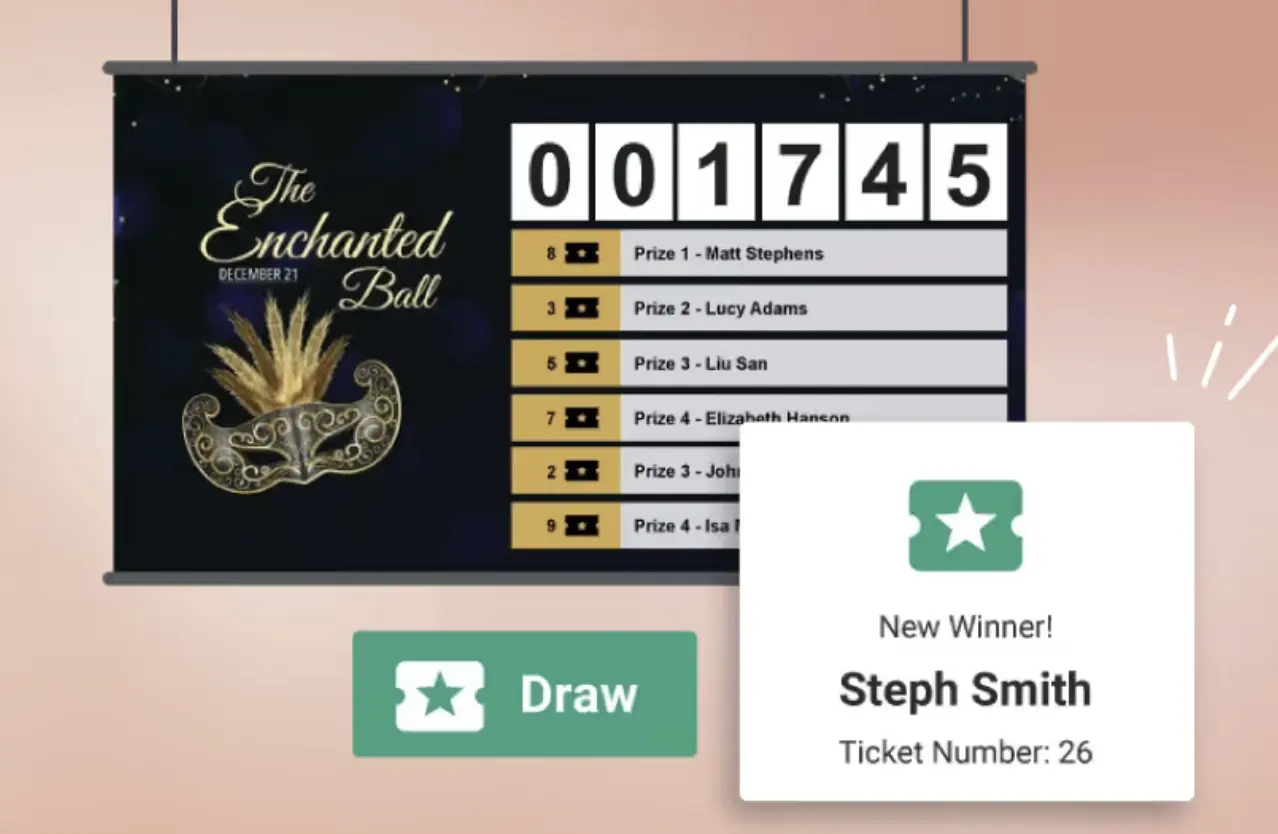
- Big-screen draw display. A dynamic draw display built for projection shows winners in real time as they're drawn. At a gala, this turns the draw into a moment: the room watches the result land on screen together, instead of someone reading a name off a laptop.
- Winners are notified automatically. The moment a ticket is drawn, the winner is notified, whether they're in the room or bought their ticket online weeks earlier from another city. No phone-tag, no unclaimed prizes sitting in a cupboard.
- Automatic winner records. Every ticket sold and every winner is recorded and downloadable as an Excel report, which covers the record-keeping most gaming authorities expect.
For a small fundraiser, this is the difference between a draw that feels like a lottery and one that feels like a favour. Your buyers are your donors, members and neighbours. Show them a fair, visible, verifiable draw and they will buy tickets again next year.

Step 7: Draw winners the right way
On draw day:
- Close ticket sales at the advertised time. Never extend quietly; it undermines trust and may breach your permit.
- Run the draw from the Raffle Controls Centre. If you're at a gala or event, put the draw display on the projector so the room sees each winner appear in real time.
- Have a second person present to witness, and record or stream the draw if you can.
- Winners are identified against their ticket numbers and notified automatically the moment they're drawn. Follow up with claim instructions for anyone not in the room, and announce publicly once prizes are confirmed.
One rule that applies everywhere: organizers and anyone handling tickets should not buy entries. It isn't worth the perception problem, even where it's technically allowed.
Raffles raise more when they're not running alone
A raffle rarely needs to be the whole fundraiser. On GalaBid, the raffle can sit inside the same campaign as event ticketing, a silent auction, live pledges and straight donations. If you are running a gala event, that combination can be very powerful.
- Event Guests register once and use one login for everything. Someone who came for the auction buys raffle tickets in two taps, because their payment details are already there.
- The raffle catches the guests an auction misses. Not everyone will bid hundreds on an auction item, but almost everyone will spend a bundle price on tickets, so the raffle monetizes the whole room, not just the top bidders.
- One checkout at the end of the night covers auction wins, raffle tickets and donations together, and everything settles to the same Stripe account.
- One set of reports afterwards, instead of reconciling a ticketing tool, an auction platform and a spinner website.
This is worth checking on any platform you compare: some treat raffles as a workaround bolted onto event tickets, with the auction on a different product entirely. If your fundraiser has more than one revenue stream, run them in one campaign.
Step 8: Thank, report, and nurture your ticket purchasers
The raffle isn't finished when the winner is drawn. This step is where a one-off ticket buyer becomes a repeat supporter.
- Within 24 hours: thank every participant, name the winners (with their permission), and state the total raised and what it will fund.
- Within a week: download your raffle report, reconcile against your Stripe account, and file any post-raffle paperwork your permit requires.
- Within a month: send a short follow-up showing the money at work. A photo of the resurfaced courts raises next year's raffle before it opens.
Because every buyer registered to purchase, you finish the raffle with a clean, exportable list of engaged local supporters. That list is often worth as much as the raffle itself.
FAQ
How much can a small organization realistically raise with a raffle?
With donated prizes and a two-to-four-week hybrid campaign, small clubs and schools commonly raise $1,000 to $10,000. The ceiling is set by prize appeal and audience size, not organisation size.
Do I need a licence to run an online raffle?
Often, yes, though many jurisdictions exempt small raffles under a value threshold. Check with your local gaming authority before announcing anything, and allow 30 to 90 days for permits where required.
What should raffle tickets cost?
Around 5 to 15% of the headline prize's retail value, with a bundle option (such as 3 for $25) to lift average spend per buyer.
Can I sell raffle tickets online and in person at the same time?
Yes, and it's often the best approach. On GalaBid, online and in-person sales run through one campaign with one continuous set of ticket numbers, so the draw covers everyone.
Can people buy raffle tickets with cash at an event?
Yes. On GalaBid, volunteers using volunteer mode can take cash payments, record the sale, and issue the buyer a numbered digital ticket on the spot. Cash buyers enter the same draw as online buyers, so one draw covers everyone and there are no paper stubs to reconcile.
How do you draw a raffle winner fairly?
Use a certified random number generator that draws directly against the tickets sold, with a witness present and, ideally, the draw shown live. GalaBid includes a certified random draw, a big-screen display that reveals winners in real time, and automatic winner notifications, so you never need to export names into a separate picker website.
Where does the money go when someone buys a ticket?
On GalaBid, payments go straight into your organization's own Stripe account. GalaBid never holds your funds, and payouts come to your bank directly from Stripe.
Can I run a raffle and a silent auction together?
Yes, and it's one of the highest-earning combinations for gala events. On GalaBid, raffles, silent auctions, live pledges, event ticketing and donations all run in one campaign, so guests register once and settle everything in a single checkout.
What is a 50/50 raffle and can I run one?
A 50/50 raffle awards half the ticket sales to the winner as a cash prize, with the other half going to your cause. GalaBid supports cash prize raffles with adjustable splits. Cash-prize raffles are more heavily regulated than prize raffles, and not permitted everywhere, so check the rules in your region before launching one.
How much does GalaBid cost for a raffle?
There are different pricing options: a free plan supported by optional donor tips, or a flat software fee with no tips shown to supporters. Payment processing fees apply on either. Payments settle directly to your organization's Stripe account on all plans.
Are raffle tickets tax-deductible for buyers?
Generally no, in most countries, because the buyer receives a chance to win in return. Donated prizes from sponsors may be deductible for the sponsor. Check local rules.
Run your raffle on GalaBid
GalaBid has been running fundraising raffles for over a decade, for nonprofits, schools and clubs in the US, UK, Australia, New Zealand, Canada and beyond. The tools in this guide aren't new features; they're what a decade of raffle draws has refined.
Pricing is flexible: choose the option that suits your organisation, from a free plan supported by optional donor tips through to a flat software fee with no tips shown to your supporters. Either way, ticket payments settle directly to your organisation's own Stripe account.
Set up takes minutes: create your campaign, connect your Stripe account, load your prizes and ticket packages, and share your link and QR code. When the tickets are sold, the certified draw and the big-screen display finish the job properly.
More advice articles about Raffle
About GalaBid
Ideal for donations. Perfect for Raffles. Awesome for Live and Silent Auctions! GalaBid’s online fundraising platform is designed for fundraisers of all types and sizes. For over 10 years we’ve been helping non-profits, charities, community clubs, churches, schools, and individuals to raise more and make a difference.