Nonprofit fundraising software can make it easier to manage donations, fundraising events, auctions, ticketing, and other activities. But processing a transaction is only one part of building a successful fundraising program.
The supporter who buys a gala ticket today might become an auction bidder, volunteer, recurring donor, or fundraiser in the future. That means nonprofits also need to think about what happens to supporter information after an event or campaign ends.
When evaluating nonprofit fundraising software, US organizations should look at both sides of the equation: how the software helps raise funds today and how the data it generates can support longer-term donor relationships.
This guide explains what to look for, where fundraising software differs from a donor CRM, and when a nonprofit may need both.
What Is Nonprofit Fundraising Software?
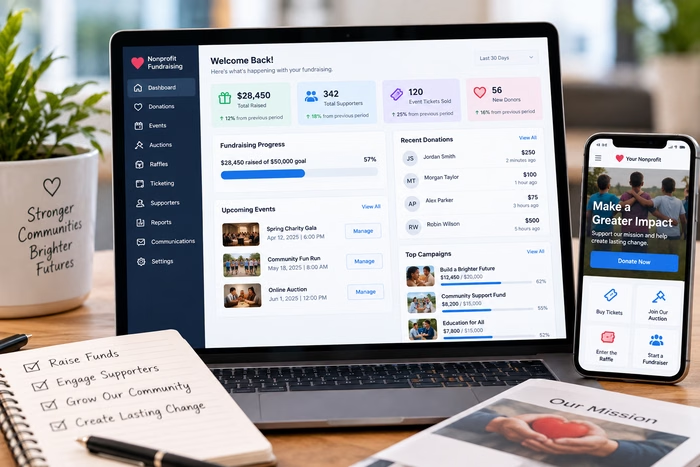
Nonprofit fundraising software is technology that helps organizations plan, run, and manage fundraising activities.
Depending on the platform, it may support activities such as:
- online donations
- charity auctions
- fundraising events
- event ticketing
- raffles
- peer-to-peer campaigns
- payment processing
- supporter information
- fundraising reports
The exact functionality varies considerably between platforms.
Some products specialize in one area, such as online donations or auctions. Others bring several fundraising activities together.
There are also broader nonprofit systems designed primarily around donor relationship management rather than running individual fundraising campaigns.
Understanding those differences is important before comparing software.
Start With the Fundraising Activities You Actually Run
A long feature list does not necessarily make one platform better than another.
Start by identifying how your nonprofit currently raises funds and what you expect to do in the future.
For example, an organization running an annual charity gala might need ticketing, an auction, donations, and event-related fundraising.
A community organization could need a straightforward donation campaign and occasional raffle.
A larger nonprofit might run multiple campaigns while also maintaining detailed donor records in a separate CRM.
Write down your actual requirements before looking at software. This makes it easier to distinguish useful functionality from features your organization is unlikely to use.
Nonprofit Fundraising Software vs. Donor CRM
Fundraising software and donor relationship management software are related, but they do not necessarily perform the same job.
Fundraising software generally focuses on helping organizations conduct fundraising activities.
Donor CRM software generally focuses more heavily on maintaining supporter records and managing relationships over time.
For example, fundraising software might tell you that someone registered for an event, bought an auction item, or made a donation.
A donor CRM may be used to build a broader record of that person's relationship with the organization, including giving history, communication, engagement, segmentation, and stewardship activity.
The distinction matters because a nonprofit should not assume that every fundraising platform is a complete CRM or that every CRM provides the tools required to run a fundraising event.
Why Supporter Data Matters Beyond a Single Transaction
Consider someone who attends your annual gala.
If your organization looks only at the event transaction, that person may simply appear as a ticket purchaser.
But their relationship with the organization could become much broader.
They might bid in the silent auction, make an additional donation, attend another event, participate in a peer-to-peer campaign, or become a recurring supporter.
Looking at supporters only as individual transactions can make it harder to understand those relationships.
When evaluating nonprofit fundraising software, consider what supporter information is collected, what you can export, what reporting is available, and how that information can work with your wider donor-management processes.
Donation Management
For organizations accepting online contributions, donation functionality is an important part of fundraising software.
Review how supporters make a donation and what happens afterward.
The experience should work well on mobile devices and clearly explain what the supporter is contributing to.
Your team should also understand how payments are processed, where funds are deposited, what information is captured, and what reporting is available.
Do not focus only on the donation form itself. Consider how the information generated by that donation fits into the organization's broader supporter records.
Auction Fundraising
Auctions introduce a different set of requirements.
Nonprofits may need to create item listings, manage bids, communicate with bidders, identify winning bids, and process payments.
For an in-person silent auction, mobile bidding can also reduce dependence on traditional paper bid sheets.
If auctions are an important part of your fundraising strategy, evaluate how deeply the software supports the entire auction process rather than simply checking whether "auctions" appears on a feature list.
The supporter experience matters too. Guests should be able to understand how to participate without unnecessary complexity.
Event Ticketing and Registration
Ticketed events create another source of supporter information.
When someone registers for a gala, dinner, community fundraiser, or other event, your organization begins another interaction with that supporter.
Fundraising software can help manage ticket sales and event registration, but nonprofits should also consider what happens to attendee information afterward.
Can your organization access the data it needs?
Can you understand which campaign or event generated the relationship?
Can the information be incorporated into your wider supporter-management process?
Event registration should not become an isolated data source that your fundraising team never uses again.
Raffles and Other Fundraising Activities
Some nonprofits also run raffles as part of their fundraising strategy.
If raffle functionality is important to your organization, evaluate whether the platform supports the type of campaign you plan to run.
US organizations should also remember that raffle laws vary significantly between states and, in some cases, local jurisdictions.
Software functionality does not determine whether a particular raffle is legally permitted. Organizations remain responsible for verifying applicable requirements before conducting a raffle.
Bringing Multiple Fundraising Activities Together
Using one system for donations, another for ticketing, another for auctions, and another for event activity can create additional administrative work.
It can also fragment supporter information.
An all-in-one fundraising platform can reduce some of that complexity by bringing multiple fundraising activities into the same environment.
That does not automatically eliminate the need for a donor CRM.
Instead, think about the roles each system performs.
A fundraising platform can manage the campaign and transaction experience. A CRM can provide the deeper relationship-management layer your organization needs over time.
What Supporter Data Should You Consider?
The answer depends on your organization's strategy and systems, but nonprofits should think beyond names and transaction amounts.
Useful information might include the campaigns supporters participated in, events they attended, donations they made, fundraising activities they engaged with, and other relevant interactions.
The important question is not simply how much data a platform collects.
Ask:
What information does our organization genuinely need to maintain supporter relationships?
Collecting unnecessary information can create additional complexity without improving fundraising.
Organizations should also handle supporter data in accordance with applicable privacy requirements and their own data-management policies.
Reporting and Fundraising Decisions
Good reporting should help your team answer useful questions.
Which campaigns attracted participation?
Which fundraising activities generated engagement?
How did supporters interact with an event?
Which campaigns should you consider running again?
Fundraising software can provide campaign-level information, while a CRM may help your organization analyze supporter relationships across a longer period.
These two perspectives can complement one another.
Campaign data helps you understand what happened during a fundraiser. Relationship data can help you understand how supporters engage with the organization over time.
Integrations Matter When Your Systems Need to Work Together
Not every nonprofit needs dozens of integrations.
If your organization already uses a donor CRM, accounting software, email platform, or another important system, determine what information needs to move between that system and your fundraising software.
Then evaluate the required integrations or data workflows.
Avoid selecting software simply because it advertises a large integration library.
The better question is:
Does it work with the systems our organization actually needs?
For some nonprofits, data exports may be sufficient. Others may need a more connected technology stack.
Mobile Experience for Supporters
Fundraising increasingly happens on supporters' own devices.
Someone might discover a campaign through email, follow a link from social media, scan a QR code at an event, or participate in an auction from their phone.
Test fundraising software from that perspective.
How easy is it to understand the campaign?
How many steps does participation require?
Can supporters bid, donate, or purchase tickets comfortably from a phone?
Does the experience require an app download?
A platform can have extensive administrative features while still creating unnecessary friction for supporters.
Both sides of the experience matter.
Ease of Use for Staff and Volunteers
Nonprofit teams do not always have dedicated technical staff.
Some campaigns are managed by small teams or volunteers who may only use fundraising software a few times each year.
That makes usability important.
Consider how long it takes to create a campaign, add fundraising activities, access reports, and make changes.
A complicated platform may provide more functionality, but those features have limited value if your team struggles to use them.
The software should fit the people who will actually manage it.
Customer Support
Fundraising events can be time-sensitive.
If an issue occurs shortly before an event or while supporters are actively participating, waiting days for an answer may not be practical.
Ask providers what support is available, when it is available, and how users access it.
This is especially important for organizations relying on volunteers or running complex fundraising events.
Human support can be just as important as technical functionality when an event is underway.
Pricing vs. Overall Value
Do not compare nonprofit fundraising software using price alone.
Different providers may use subscription fees, platform fees, payment processing charges, optional contributions, service packages, or other pricing models.
Start by understanding the complete model.
Then consider what the software could replace.
If one platform manages ticketing, auctions, donations, and other activities, compare that with the cost and administrative effort of maintaining several separate systems.
The lowest advertised price does not automatically represent the lowest overall cost for your organization.
Questions to Ask Before Choosing Nonprofit Fundraising Software
Before committing to a platform, your nonprofit should be able to answer a few practical questions.
What types of fundraising campaigns do we run?
Which features will we actually use?
How easy is the platform for supporters?
How easy is it for staff and volunteers?
How are payments handled?
What supporter information can we access?
What reporting do we need?
Do we already use a donor CRM?
Does information need to move between the fundraising platform and our CRM?
What customer support is available?
What is the complete pricing model?
Answering these questions can narrow your options considerably.
Do You Need Fundraising Software, a CRM, or Both?
There is no universal answer.
A smaller nonprofit may primarily need software that helps it run fundraising campaigns efficiently.
Another organization may need a dedicated CRM because it manages a large supporter database and has more complex stewardship and communication requirements.
Some nonprofits need both.
Think of the systems as serving different parts of the supporter relationship.
Fundraising software helps people participate.
A donor CRM helps organizations manage longer-term relationships.
When both are required, the important consideration becomes how information moves between them and how your team will use it.
How GalaBid Fits Into a Nonprofit's Fundraising Technology
GalaBid focuses on helping organizations run fundraising activities rather than positioning itself as a replacement for every nonprofit system.
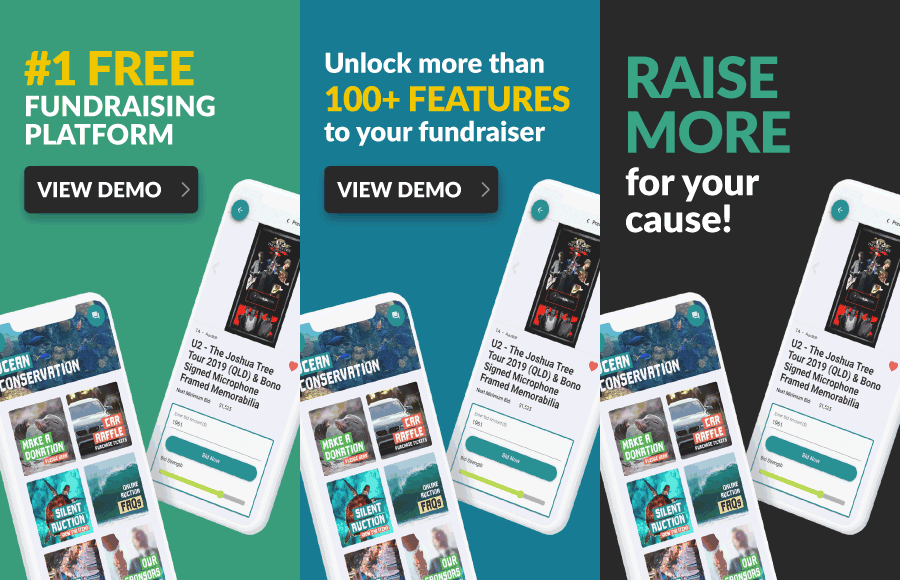
Organizations can bring fundraising activities such as auctions, raffles, ticketing, and donations together in one place, reducing the need to manage a separate platform for each activity.
Guests can participate using their own devices without downloading an app. GalaBid also provides real human support 24/7, and funds never touch GalaBid.
For organizations that require deeper donor relationship management, a dedicated CRM may still form part of their broader technology stack.
The important thing is to choose technology based on the job it needs to perform.
Look Beyond the Next Transaction
Choosing nonprofit fundraising software should not be reduced to finding a system that can process a payment.
Think about the complete fundraising journey.
How will supporters discover your campaign? How will they participate? What information will your team receive? What happens to that information after the campaign? How will you continue the relationship?
The right setup may involve fundraising software, a donor CRM, or a combination of systems.
What matters is creating an experience that works for supporters today while giving your organization the information and tools it needs to build relationships beyond a single event or transaction.
Bring Your Fundraising Activities Together With GalaBid
Whether you're planning an auction, raffle, ticketed event, or donation campaign, GalaBid helps organizations manage multiple fundraising activities in one place while keeping participation simple for supporters.
With no app required for guests, real human support available 24/7, and funds never touching GalaBid, your team can focus on running the fundraiser and engaging the people behind every contribution.
Explore GalaBid's fundraising tools and see pricing for your region.
More advice articles about Fundraising
About GalaBid
Ideal for donations. Perfect for Raffles. Awesome for Live and Silent Auctions! GalaBid’s online fundraising platform is designed for fundraisers of all types and sizes. For over 10 years we’ve been helping non-profits, charities, community clubs, churches, schools, and individuals to raise more and make a difference.