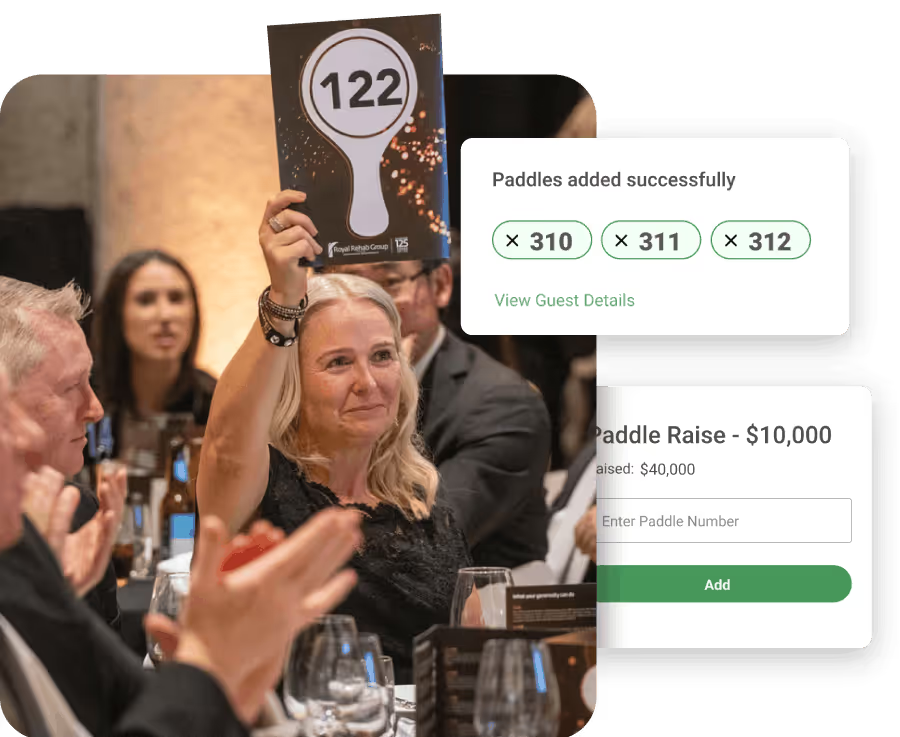
There’s more than one way to run a fundraising auction. You can run a silent auction, live auction, sealed bidding or Buy It Now. You can run the whole auction online, without an event at all. And at many galas, there’s also a Fund-a-Need - not an auction, but often the biggest fundraiser of the night.
If you’ve started researching your options, you’ve probably seen each format described as the “best”. That’s not particularly helpful when you’re trying to plan one event.
The good news? You don’t have to choose just one. These formats work in different ways and can complement each other. A silent auction gets lots of people bidding on multiple items. A live auction creates competition between bidders for a smaller number of high-value items. A Fund a Need asks guests to give because they believe in the cause, with no item required.
This guide breaks down what each format does, what you’ll need to run it, and how to put them together into a fundraising event that works for your audience.
The Short Answer
Before we get started, the quick answer to which format raises the most is...it depends!
A live auction raises the most from a single item. A silent auction usually raises more in total, because it earns from how many people take part. And a fund a need is often the biggest single line of the night. Events may choose to run all three, with the silent auction open all evening, the live auction from the stage, and the fund a need straight after it.
The right choice and combination for YOUR event is what matters. We'll get to the detail further on, but as an overview, we've created a comparison table to give you a quick reference as you complete your research:
The Five Formats
The table above is the quick version. This section explains each format properly, so you can work out whether it fits your event before you plan around it.
Silent Auction
Items open for a set period and supporters bid from their phones, with the highest bid at close winning. It carries breadth: twenty, fifty or a hundred items running quietly through an evening or across a week.
Silent auctions raise from the number of people bidding rather than from any single lot. That makes them the base layer of almost every fundraising event, and the format to get right first.
Live Auction
A small number of lots sold from the stage by an auctioneer, in front of the room. It works on drama and competition between two people who both want the same thing.
Live auctions raise from depth rather than breadth. A handful of lots can out-raise a hundred silent items, but only if the lots deserve the room's attention and the auctioneer is good. A weak live auction costs you more than not having one, because it takes the energy out of the evening.
The auctioneer matters more than the lots. This is the part organisers underweight most. The same three items in front of the same room will raise very different totals depending on who is holding the microphone, and the gap is not small. A professional benefit auctioneer, many of whom hold the Benefit Auctioneer Specialist designation, knows how to open, when to slow down, how to pull a second bidder back in, and when to stop. A well meaning board member or local celebrity usually does not, and the room can feel it.
If your live auction is worth running at all, it is worth paying someone who does this for a living. If the budget will not stretch to one, that is a reason to drop the live auction and put the lots into the silent auction rather than a reason to hand the microphone to a volunteer. Ask other organizations in your area who they use, and ask what their live auction raised before and after they started using them.
Sealed Bidding
Bids stay hidden until the auction closes. Nobody knows what anyone else has offered, so supporters bid what the item is worth to them rather than one increment above the last person.
Useful for items where public bidding would suppress the price, or where you want to sell to several winners at once. Underused, and worth testing on one or two lots. Where you are selling several of the same thing, see how bidding works when the quantity is more than one.
Buy It Now
A fixed price, available immediately. It captures the supporter who wants the item without the contest, and it lets you sell multiples of the same thing.
Set on an auction lot at 150% to 200% of fair market value, a widely used convention, it gives an exit to the bidder who would otherwise drop out. As a stand alone format it turns unsold stock and merchandise into revenue. The help centre covers adding Buy It Now to an item and selling items that received no bids after the auction closes.
Online Only Auction
No event at all. The auction runs for days or weeks, supporters bid from wherever they are, and it closes on a date you set.
The audience is your whole mailing list rather than the people who can fill a room, which suits organizations with supporters spread across a wide area or without the budget for a venue.
Fund a Need (Which Is Not an Auction)
Worth including here because it sits inside the same evening and is often the largest single line of the night. In a fund-a-need (also called a paddle raise) supporters give at suggested levels toward a specific purpose and receive nothing in return.
That last point is what makes it different from every format above. There is no item, so there is no ceiling set by what the item is worth, and no supporter deciding whether the price has gone past what the thing is objectively worth. People give what the cause is worth to them.
Note to US fundraisers: It is also why a fund-a-need gift is treated differently by the IRS. Because the supporter receives nothing in return it is not a quid pro quo contribution, so the full amount is generally deductible, unlike a winning bid where only the amount paid above fair market value counts. Written acknowledgment is still required at $250 or more. Saying that from the stage lifts giving, and it is one reason fund a need often outperforms the live auction it follows.
Run it immediately after the live auction, while the room is warm. See fund a need and paddle raise for how it works in practice.
Compare Them Side by Side
Running More Than One Format Together
Different formats can work together really well. A silent auction can open as guests arrive and run throughout dinner, giving people something to do between the main parts of the evening. A short live auction can then take centre stage once everyone is seated. Buy It Now can run alongside both, giving guests a way to purchase without competing in a bidding war. Then, while the room is engaged, you can move into a Fund a Need appeal.
Used together, each format has a different job. The silent auction gets plenty of people involved, the live auction creates excitement around a smaller number of standout items, and the Fund a Need gives guests the opportunity to support your cause directly.
What That Looks Like in Practice
The Dravet Syndrome Foundation is a small US organisation funding research into Dravet syndrome, a rare seizure disorder. Meredith Bankston runs its largest gala in St Louis, which is now in its eighth year and attracts more than 400 guests.
Rather than choosing one format, they combine several. As Meredith explains:
“We do have silent auctions, live auctions. We do a paddle raise which we call a bid for a cure, and then we have a local band come in and we dance the night away.”
That combination raised more than $96,000 at a single event last year. It’s a good example of how different formats can complement each other: the silent auction engages a broad group of guests, the live auction creates competition around higher-value items, and the paddle raise gives people another way to give without buying anything.
What Can Get in the Way
Running multiple formats can work well, but the order and execution matter.
Running the live auction too late.
By the end of a long evening, guests can be tired and ready to leave. Keep the live auction relatively short and put it somewhere in the program when you have the room's attention.
Running the silent and live auctions at the same time.
You want guests focused on the live auction when it starts. Close the silent auction beforehand, rather than asking people to choose between bidding online and watching the stage.
Putting the wrong person on the microphone.
A live auction relies heavily on energy, timing and the ability to encourage competition. If you don't have someone confident and experienced, consider moving those items into your silent auction instead.
Having too many live lots.
A live auction doesn't need to be long to be effective. A handful of strong items can create much more excitement than a long list of lots that loses the room's attention.
Only offering high-value items.
Not everyone will be ready to bid on a $2,000 package. Including a range of items gives more guests an opportunity to participate.
Not having someone available to help.
Some guests will need a little help getting started with mobile bidding. Having a volunteer nearby can make a big difference, particularly for guests who aren't comfortable with technology.
What Every Format Needs to Get Right
Pricing
Getting your starting prices and bidding increments right can have a big impact on the final result.
An analysis of more than 4,200 not-for-profit auctions and over three million bids, carried out by Momentive Software and published by the Association of Fundraising Professionals, suggests opening bids at around 30% to 50% of fair market value, with bidding increments of around 10%. The analysis found the average winning bid was nearly $380 USD.
The key is to make it easy for people to start bidding while leaving enough room for the item to build momentum. GalaBid also provides guidance on setting bidding increments and adding reserves where you have paid for an item.
Items
The same analysis found that sports and hobbies, one-off experiences, and arts and entertainment attracted some of the highest final prices. Pets, travel and experiences, and food and wine attracted the most bids.
A strong catalogue needs a mix of both: items that can generate a high final price and items that encourage lots of people to get involved.
Our guide to auction items, ideas and sourcing looks at what tends to perform well and which items can be harder to sell.
Getting Everyone Bidding
One of the biggest factors in auction revenue is participation. The more people who bid, the more opportunity there is for competition to build.
That is one reason mobile bidding can be so useful. The Momentive analysis found that mobile bidding generated around 30% more revenue than paper bid sheets.
Beth Butchino at the Salvation Army of Greater Charlotte has experience with both approaches. Their annual fashion show and silent auction previously used three-part paper forms, and collecting the slips and calculating the totals took around half of their admin team on the night.
After moving online, the experience changed significantly:
“They can go sit at their tables, they can get their notifications, and then they continue to participate regardless of what else they're doing or where they are.”
The other important part of participation happens before the first bid: sign-up. Every extra step creates another opportunity for someone to drop off. That's why connecting ticketing and bidding can make a bigger difference than you might expect.
Closing Cleanly, and Why Overtime Matters
The final few minutes can be some of the most valuable in an auction. Bidders who have been watching an item all evening have a reason to make one last bid, while anyone who has just been outbid still has a chance to respond.
Without overtime, that competition can stop simply because the timer reaches zero. Automatic overtime extends an item when a last-minute bid is placed, giving other bidders a chance to respond. The auction ends when the bidding ends, rather than simply when the clock runs out.
It's a simple feature, but one that can help protect those valuable final bids. See how overtime works in the help centre for information on setting the extension length.
If You're Fundraising in the US
This section applies to organisations fundraising in the United States. If you're fundraising elsewhere, local tax and receipting rules will be different. Treat this as a general illustration of why the format you choose can affect how donations are handled.
A winning bid is a quid pro quo contribution, because the supporter receives an item in return. Generally, only the amount paid above the item's fair market value is deductible, and the IRS requires a written disclosure statement where the payment exceeds $75. The IRS explains this in its guidance on quid pro quo contributions.
A Fund a Need gift is different, because the supporter doesn't receive anything in return. Generally, the full amount can be deductible.
Written acknowledgment is required at $250 or more in either case. IRS Publication 1771 explains the relevant substantiation and disclosure requirements.
Keeping a record of each item's fair market value when you list it can make reporting much easier later. Your CPA or tax adviser should confirm what your organisation needs to include on receipts.
The Auction Is Not the Only Fundraising Opportunity
It's easy to think of the auction as the main event and everything else as logistics. But other parts of your fundraising event can make a significant contribution too — and some may generate more revenue than the auction itself.
Ticketing
Ticket sales are often one of the biggest sources of revenue at a fundraising event, and that money comes in well before the first auction bid.
Ticketing also plays an important role in the auction itself. When ticketing and bidding are connected, supporters can register once and move from buying a ticket to participating in the auction without creating a second account. That removes friction at exactly the point when you want people to start bidding.
With separate systems, a supporter might buy a ticket months before the event and then be asked to register again when they arrive. The extra step may seem small, but it can stop people from participating.
See event ticketing to learn how GalaBid connects ticketing and fundraising in one campaign.
Donations at Checkout
You don't always need to make a separate donation ask. Giving supporters the option to donate while they're already checking out can make it easier for them to contribute.
It can also give people who bid but didn't win an easy way to support your cause, something worth considering when most auction participants won't take home an item.
Filling the Top of the Catalogue
Whatever combination of formats you choose, you'll usually face the same challenge: finding standout/highlightl items.
The items that attract the highest bids can also be the hardest to secure as donations. Auction items on consignment can help fill those gaps without requiring you to purchase items upfront.
With consignment items, you list the item without paying upfront and are charged only when it sells. If an item doesn't sell, there is no charge. The difference between the cost price and the amount raised goes towards your cause.
After the auction, GalaBid's Redemptions Concierge team handles booking and fulfilment, so your volunteers don't have to manage the process themselves.
Consignment can work particularly well for live auctions, where you may want a small selection of high-value lots, as well as Buy It Now items where the cost price is known before you list them.
Choosing the Right Combination for Your Event
There's no single formula that works for every fundraiser. Your guest numbers, venue, audience, available time and auction items all matter.
Seated dinner, 100 to 300 people, with a strong headline item:
Silent auction + short live auction + Fund a Need.
Seated dinner without a headline item:
Silent auction + Buy It Now + Fund a Need. There's no need to force a live auction if you don't have the right items.
Standing or informal event:
Silent auction + Buy It Now. A live auction generally works better when guests are seated and focused on the stage.
No event at all:
Run an online auction over one to two weeks, with a clear closing date.
School or community fundraiser on a smaller budget:
Silent auction + raffle where permitted by local regulations, with consignment items helping to build out the catalogue.
Two Questions Worth Asking Any Platform
Whichever format you choose for your event, it's highly likely you'll use an online fundraising platform to help you manage your chosen format/s.
These two questions are worth asking before you commit to a particular platform:
1. Where Do the Funds Go?
There are two common models. Payments may settle into your organisation's own account, or they may first go through the platform's account before being transferred to you.
Neither model is automatically right or wrong, but it's important to understand where your funds are held and when you'll receive them.
Ask which merchant account payments settle into, how long payouts take, whether funds are held separately from the platform's operating funds, and what the terms say.
With GalaBid, you connect your organisation's own Stripe account. Supporters pay into it directly, and payouts are made to you according to Stripe's schedule. GalaBid does not hold your campaign funds or add a markup to Stripe's processing fees.
2. Is There a Real Person Available When You Need Help?
Your auction might close at 9pm on a Saturday evening. That's exactly when you may need help with a bid, a timer or an item. Before choosing a platform, ask when support is available, whether you'll be speaking to a person, and what happens if you need help during your event.
GalaBid offers live chat support delivered by real people around the clock, along with remote account support and onsite options for larger events.
Frequently Asked Questions
What Is a Fundraising Auction?
A fundraising auction is an auction held to raise money for a cause or organisation. Items may be donated, purchased or supplied on consignment. Common formats include silent, live, sealed bidding, Buy It Now and online auctions.
Which Auction Format Raises the Most?
It depends on your event and audience. Live auctions can generate strong results from a small number of high-value items, while silent auctions can involve a much larger number of people. A Fund a Need can also generate significant revenue because guests are giving directly to the cause rather than bidding for an item.
Can We Run More Than One Format at the Same Event?
Yes. Combining formats can give guests different ways to participate. A common approach is to run a silent auction throughout the event, add a short live auction, offer Buy It Now items and finish with a Fund a Need.
How Many Items Does a Fundraising Auction Need?
There's no fixed number. As a starting point, some organisers use around one silent auction item for every four guests, while live auctions typically work better with a smaller number of standout lots.
The right number depends on your audience, event length and the quality of your items.
Do We Need an Auctioneer?
You don't need an auctioneer for silent, sealed, Buy It Now or online auctions. A live auction is different: an experienced auctioneer can help create energy, competition and momentum in the room.
Should We Pay for a Professional Auctioneer?
If you're planning a live auction, it's worth considering. If you don't have an experienced person available, moving your best items into the silent auction may be a better option than running a live auction without someone who can confidently manage the room.
Can a Fundraising Auction Run Without an Event?
Yes. An online-only auction can run for days or weeks without a physical event, allowing supporters to participate wherever they are and removing venue and event costs.
Are Fundraising Auction Purchases Tax Deductible in the US?
Only in part. A winning bid is generally treated as a quid pro quo contribution because the supporter receives an item in return. The deductible portion is generally the amount paid above the item's fair market value, subject to IRS rules.
A Fund a Need gift is different because the donor doesn't receive something in return. US organisations should follow the IRS requirements and confirm their specific circumstances with a tax professional.
Does the Platform Hold Our Funds?
It depends on the platform. Ask whether payments settle into your organisation's own merchant account or the platform's account, how long payouts take and whether the platform holds your funds before paying you.
With GalaBid, organisations connect their own Stripe account, so campaign funds settle directly into that account.
Should We Sell Tickets Through the Same System?
If possible, yes. Connecting ticketing and bidding means supporters can register once and then participate in the auction without creating another account. That can make it easier for more guests to get involved.
What Software Do We Need?
Look for a platform that supports the fundraising formats you plan to use and makes it easy for supporters to register, participate and pay.
GalaBid brings silent, live, sealed and Buy It Now auctions together with Fund a Need donations, raffles, ticketing and other fundraising tools in one campaign.
More advice articles about Fundraising
About GalaBid
Ideal for donations. Perfect for Raffles. Awesome for Live and Silent Auctions! GalaBid’s online fundraising platform is designed for fundraisers of all types and sizes. For over 10 years we’ve been helping non-profits, charities, community clubs, churches, schools, and individuals to raise more and make a difference.