The best online auction platform for most US nonprofits in 2026 is the one that lets you run the whole auction from a browser, keeps platform fees low, and pays funds straight into your own account. GalaBid, RallyUp and 32auctions do that. Givebutter and BetterWorld hold your funds first. Handbid and OneCause are built for big in-room galas and priced to match.
This guide compares eight platforms on what they cost in the US, what card processing adds, where your funds sit after a winning bid, and who each one suits. Pricing was checked in September 2026 against each vendor's published US rates and Capterra listings.
The Best Online Auction Platforms Compared
Ratings are from each platform's Capterra listing as of September 2026. Vendor pricing changes, so confirm current rates before you commit.
What Makes an Online Auction Platform Different From Silent Auction Software
An online auction platform runs the entire auction on the web. There is no ballroom, no bid sheets, and no closing time tied to a dinner. Supporters bid from their phones over days or weeks, wherever they are, and pay online the moment they win.
Silent auction software is built around an event. It still uses online bidding, but other features and event specific tools are paramount: sms outbid notifications; leaderboards; personal shopper accounts and integrations with event ticketing, paddle raises and live auctions. If that is your event, read our silent auction software comparison instead.
For a fully online auction, four things decide the result: how easy bidding is on a phone, what the platform takes, where the funds land, and whether you can add ticketing, raffles or donations to the same campaign without paying twice.
The 8 Best Online Auction Platforms Reviewed
1. GalaBid: Best All-Round Online Auction Platform for Nonprofits
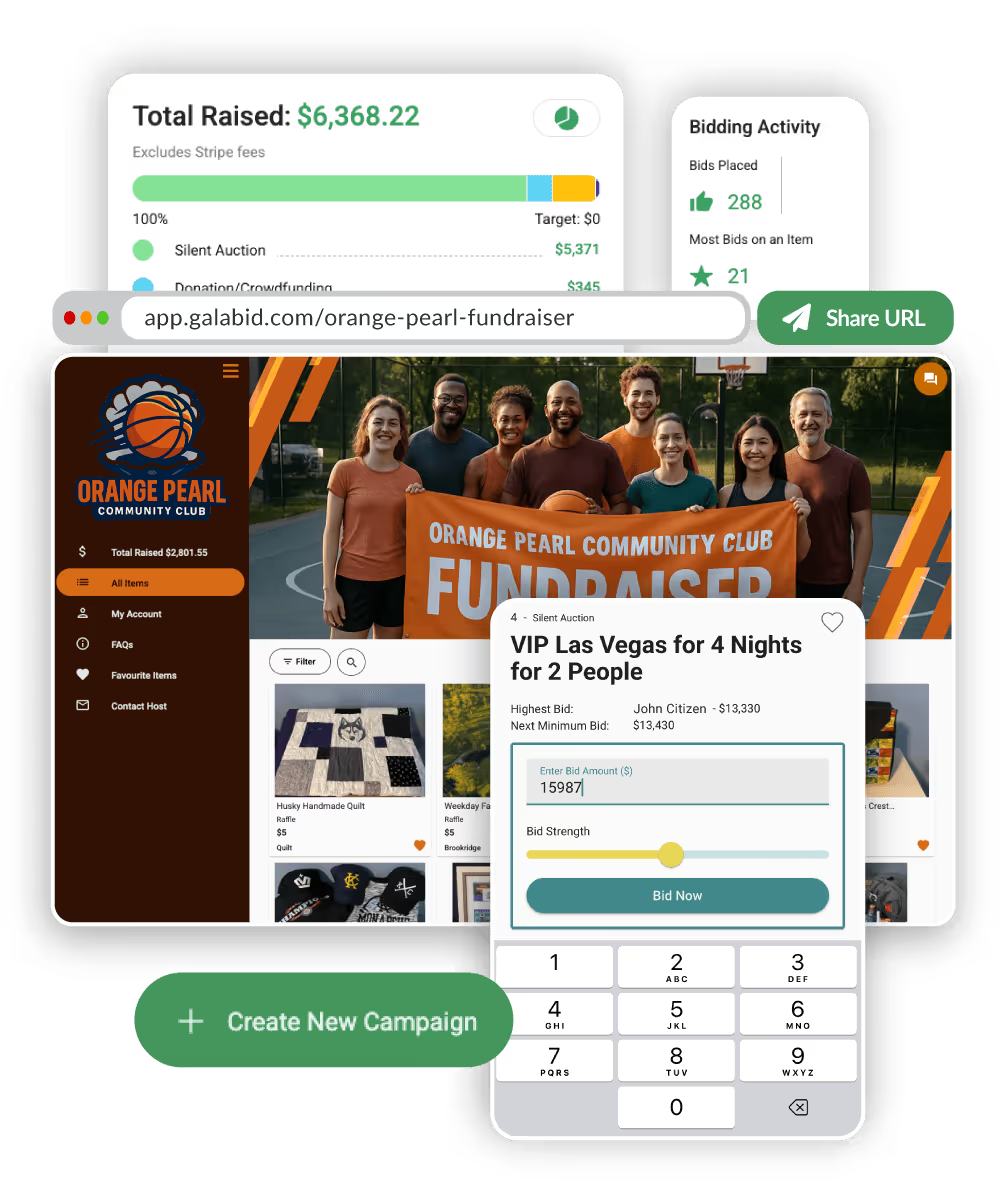
GalaBid is the best fit for most US nonprofits running an online auction because every feature is included on every plan, and funds never pass through a holding account. Bidders register by text or email, bid from any browser, and pay securely online.
Pricing in the US is simple. The Free plan carries no platform fee and is funded by optional supporter tips, with 10% of those tips shared back to your cause. If you would rather your supporters never see a tip prompt, the Pro plan charges 4.9%. Larger campaigns can pay a flat US$1,250 upfront. Details are on the GalaBid pricing page.
Payments run through Stripe at Stripe's own rates with no markup, and you choose whether to pass processing fees on to participants. Because Stripe is connected to your account, funds settle straight to your bank on Stripe's normal schedule. GalaBid doesn't process or hold your funds.
The bidding tools are built for auctions that run without an event. Overtime extends the close by a set number of seconds whenever a late bid lands, so nobody wins by sniping in the final moments. Max bidding lets a supporter set a private ceiling and have the platform bid for them in increments. Sealed bids hide all bids until close, which suits high-value items where you want one best offer.
Fulfillment is easily handled too. You can add shipping costs per item, collect winners' addresses at checkout and mark items as dispatched. A Buy It Now price lets a supporter skip the bidding war. Reserve prices protect high-value items, and anything that stalls can be sold after the auction closes. Winners can add a donation at checkout, and you can apply sales tax or a fee to specific items where your state requires it.
Support comes from real people rather than chatbots, round the clock, from setup through the final close. The same campaign can run a raffle and take donations, so a supporter who misses out on an item can still give. Rated 4.8 on Capterra from 55 reviews. See the online auction platform in detail.
2. RallyUp: Best for Mixing Campaign Types
RallyUp is the strongest alternative if you want an online auction alongside raffles, sweepstakes, a-thons or crowdfunding under one roof. Its published fee tiers are unusually clear, and it pays out to your own Stripe as bids are collected rather than after the campaign ends.
The Free plan requires supporter tipping to be shown at checkout. The Flex plan removes that and charges 4.9% on auction proceeds, capped at $100 per item. Processing runs 1.9% to 2.9% plus $0.30. Rated 4.7 on Capterra from 61 reviews.
3. Givebutter: Best for Auctions Inside a Broader Campaign
Givebutter suits nonprofits that want auctions as one module in a wider fundraising and CRM platform. The free plan (US) has no contact limits and covers auctions, forms, events and a supporter database.
The fee model is tip-funded. With tips on, Givebutter charges no platform or processing fee. Turn tips off and you pay 3% plus 2.9% + $0.30 on cards. Funds go into a Givebutter Wallet daily, and you withdraw to your bank from there. Rated 4.8 on Capterra from 872 reviews. We compare it directly in GalaBid vs Zeffy vs Givebutter.
4. 32auctions: Best Budget Option for Small Online Auctions
32auctions is the cheapest way to run a small, purely online auction where payments are managed outside the platform. The free tier allows 20 items with one image each and shows third-party ads on your page. Upgrades for more items, more images and ad removal are priced per event, with the most popular bundle quoted at around $170.
If you collect payments through the platform, 32auctions charges its own 2.9% + $0.40 per payment in addition to the Stripe or PayPal fee. That doubles the processing cost to about 5.8% + $0.70 per card payment, though participants can be asked to cover it. Manage payments yourself and there is no 32auctions transaction fee. Funds go direct to your own Stripe or PayPal. Rated 4.0 on Capterra from 14 reviews.
5. BetterWorld: Free Tooling With an Escrow Catch
BetterWorld offers a free plan (US) with no stated limits, funded by optional supporter contributions, and its auction pages look good. Paid tiers run from a 2.2% to 5% Flex plan up to $5,950 a year for KeyStone.
The catch is the payout. BetterWorld holds funds in its own escrow account, releases them six days after receipt, and charges $2.25 plus 0.25% per withdrawal. Rated 4.6 on Capterra from 57 reviews.
6. Handbid: Best for Hybrid Galas With Live Support
Handbid is a dedicated bidding app that shines when part of your audience is in the room. Check-in, live bidding, paddle raise and phone support during the event are all included. There is no free tier and no published pricing; you get a quote after a call. Capterra lists it from $1,999 a year.
Card rates are the highest here at 3.5% + $0.30, or 3.95% + $0.30 on Amex, and they apply even when payments run through your own Stripe account. Stripe's published US rate is 2.9% + $0.30 for all cards, so the extra 0.6 points (1.05 on Amex) is Handbid's margin on processing. Handbid says there is no platform percentage on top of that, which is true, but the card rate is where the platform fee lives. Connect your own Stripe and funds flow direct. Skip that step and Handbid pays by check two to three weeks after settlement, plus a $100 fee. Rated 4.7 on Capterra from 44 reviews, with reviewers flagging setup complexity.
7. OneCause: Best for Large Enterprise Nonprofits
OneCause is the enterprise choice for organizations running several large galas a year. Pay-as-you-go starts at $200 plus a 5% fee on funds raised, or you can take the Professional package at $2,995 a year and avoid the percentage. Processing is advertised from 2.0%, but the full rate card and payout terms are not published.
The platform is deep and the support is heavy, which is why it scores 4.7 on Capterra from 388 reviews. Reviewers also mention complex onboarding. For a single online auction it is more platform than most nonprofits need.
8. AirAuctioneer: Best for Paying Per Item
AirAuctioneer charges by the item instead of by the event. You get 5 free credits to start, then buy bundles from $30 for 5 items up to $180 for 200. There is no commission and no account fee, and Stripe processing is charged at 2.9% + $0.30 with no surcharge.
It has no Capterra listing and only a handful of Trustpilot reviews, so there is little independent signal on support or reliability. Payout timing is not published. It is worth a look for a small auction where you know your item count and want a predictable cost.
Where Your Funds Go After a Winning Bid
Whether the platform holds your funds is the most overlooked difference between online auction platforms, and it splits this list cleanly.
GalaBid, RallyUp and 32auctions connect to your own Stripe account, so each payment settles to your bank on Stripe's normal schedule. Handbid does the same only if you set up Stripe before the auction opens. Givebutter and BetterWorld collect into their own wallet or escrow first, then release funds on their terms. OneCause and AirAuctioneer do not publish their payout terms.
A holding account is not always a problem. It becomes one when a grant match, a venue deposit or a program payment is due in the days after the auction closes, or when a withdrawal fee eats into a small campaign. Ask any vendor for the payout timing in writing before you sign.
How to Choose an Online Auction Platform
Check the Real Cost, Not the Headline
Most platforms on this list advertise a free plan (US). The cost sits elsewhere: supporter tips, percentage fees, withdrawal charges or card rates above the Stripe standard. Stripe's published US rate is 2.9% + $0.30. Handbid charges 3.5% + $0.30 on your own Stripe account, and 32auctions adds a second 2.9% + $0.40 of its own. Work out what a $20,000 auction would cost on each plan, including processing, and compare that figure.
Test the Bidding Experience on a Phone
Most bids in an online auction come from a phone. Register as a bidder on a demo, place a bid, get outbid and pay. If any of those steps takes more than a few taps, supporters will drop out at the same point.
Look for the Features That Matter Without an Event
In an event-night auction, the auctioneer and speeches all create urgency, and winners collect their items on the way out. Online, the software has to do both jobs. Five features carry most of that load.
1. Overtime, sometimes called auto-extend or anti-sniping, pushes the closing time back by a few minutes whenever a bid arrives near the end. Without it, bidders wait until the last ten seconds and the item closes below what people were willing to pay.
2. Max bidding lets supporters set the most they will pay and have the platform bid on their behalf in increments. It keeps people in the auction when they cannot watch their phone, which over a week-long campaign is most of the time.
3. A live activity feed and comments board along with outbid alerts by text turn a functional page into an active virtual community and an exciting contest. Sealed bids are worth having for one or two headline items where a single best offer beats a public bidding war.
4. Shipping is the one most platforms ignore. An online auction needs shipping costs on each item, the winner's address captured at checkout, and a way to track what has been sent. Without it, your team is chasing addresses by email for a week after close.
Not every platform in this comparison offers all four, and some reserve them for higher tiers. Ask before you commit.
Count the Features You Will Need on Every Plan
Ticketing, raffles, donations and SMS notifications are often add-ons or reserved for higher tiers. If you plan to run more than an auction, a platform that includes everything on every plan avoids a surprise upgrade halfway through the campaign.
Confirm Payout Terms in Writing
Ask where funds sit, how long until they reach your bank, and what each withdrawal costs.
Frequently Asked Questions
What Is the Best Free Online Auction Platform for Nonprofits?
GalaBid, Givebutter, RallyUp and BetterWorld all offer a free plan in the US, each funded by supporter tips or contributions. GalaBid includes every feature on the free plan and pays funds direct to your own Stripe account. Givebutter and BetterWorld hold funds in a wallet or escrow first, and BetterWorld charges a withdrawal fee.
How Much Does an Online Auction Platform Cost?
It ranges from nothing beyond card processing to several thousand dollars a year. Tip-funded free plans sit at one end. Percentage plans run about 3% to 5% of proceeds. Annual licenses from Handbid and OneCause start at roughly $2,000 to $3,000. Card processing of 2.9% + $0.30 or more applies on top in almost every case.
Can Supporters Bid on an Online Auction From Their Phone?
Yes. Every platform in this comparison supports mobile bidding through a browser, and some also offer an app. GalaBid bidders register by text or email and bid from any phone without downloading anything, which removes the biggest barrier to first-time bidders.
How Long Should an Online Auction Run?
A few days up to a week works for most nonprofits. That is long enough to promote the auction twice and let bidding wars build, but short enough to keep urgency. Platforms that support outbid notifications by SMS keep supporters engaged across the full window.
Does an Online Auction Platform Handle Sales Tax or Charitable Receipts?
Most platforms, GalaBid included, can issue payment confirmations and export transaction data, but they do not determine your tax obligations. Rules on sales tax and the deductible portion of a winning bid vary by state and by item. Check with your accountant or the IRS guidance on quid pro quo contributions.
Run Your Next Online Auction on GalaBid
Every feature, on every plan, with funds going straight to your own Stripe account. Set up your online auction in minutes, or talk to the team about which US plan fits your campaign.
More about
Silent Auction
About GalaBid
Ideal for donations. Perfect for Raffles. Awesome for Live and Silent Auctions! GalaBid’s online fundraising platform is designed for fundraisers of all types and sizes. For over 10 years we’ve been helping non-profits, charities, community clubs, churches, schools, and individuals to raise more and make a difference.