Choosing a fundraising platform isn't just "free vs paid." It affects how you collect funds, who holds your money, how you report to your board, and what you can actually run: a simple donation page, or a full fundraising event.
GalaBid and Zeffy both offer no-upfront-cost models, but they're built for different jobs. Here's a clear, accurate breakdown to help you decide, and where GalaBid stands as a Zeffy alternative.
This post breaks down three of the most talked-about options (GalaBid, Zeffy, and Givebutter) with honest pros and cons for each. We'll look at pricing models, tip and revenue share structures, fixed fee options, platform strengths, and where each one falls short.
Head-to-Head Comparison
How each platform actually makes money
All three platforms use some version of the tip model: supporters are prompted to tip the software provider at checkout. They all allow supporters to opt out at no cost to the fundraiser. The differences are in the defaults, the alternatives, and where the money goes.
GalaBid suggests a tip to winning bidders and buyers at checkout on the Free plan, with suggested amounts capped at 15% of the transaction, below where Zeffy's defaults start for smaller gifts. Supporters can opt out with no penalty to the fundraiser. GalaBid then shares 10% of the tips collected on your campaign back with your cause, which no other platform in this comparison does. If you would rather your supporters never see a tip prompt, the Pro plan replaces tips with a 4.9% fee and the Flat Fee plan replaces them with a single upfront price. Full details are on the GalaBid pricing page.
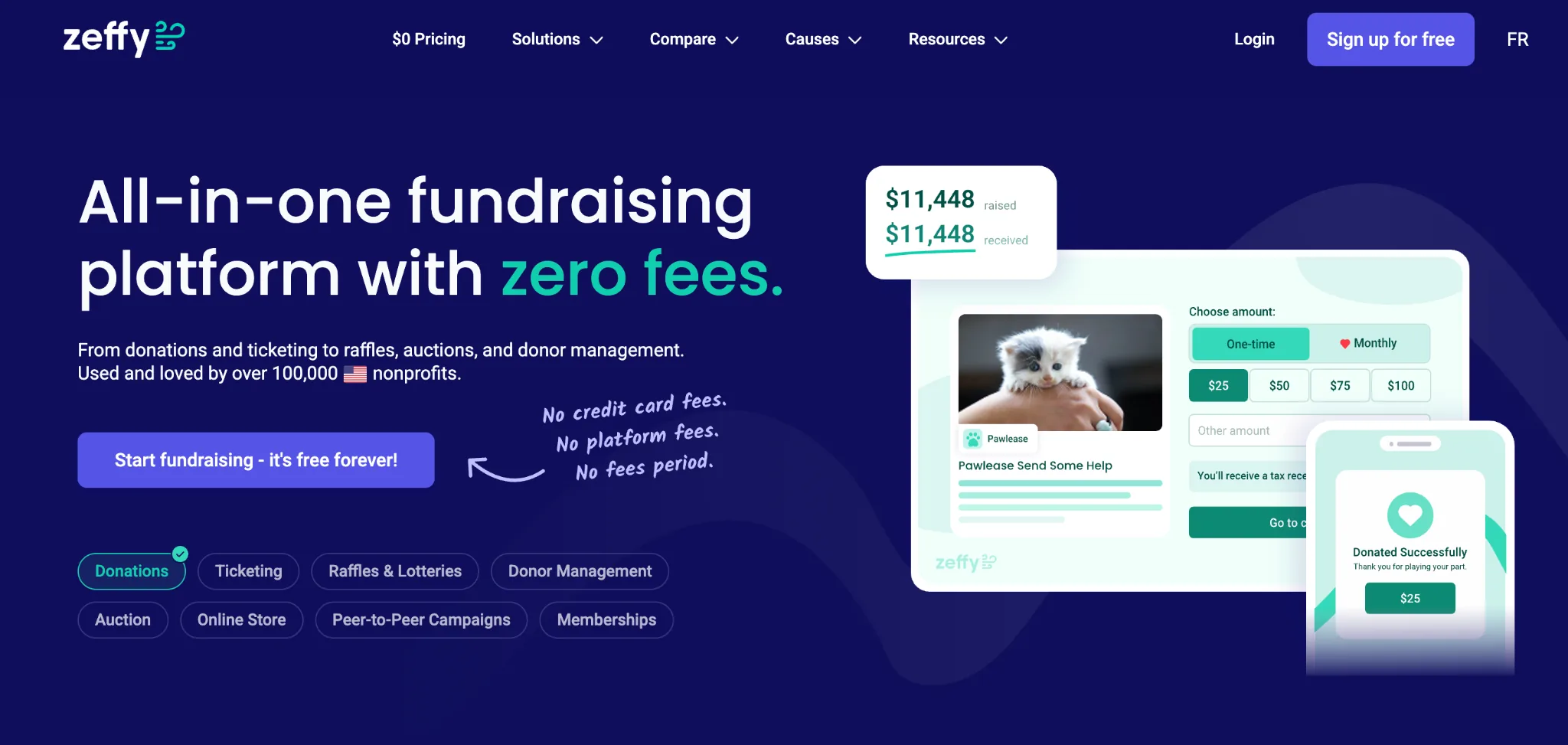
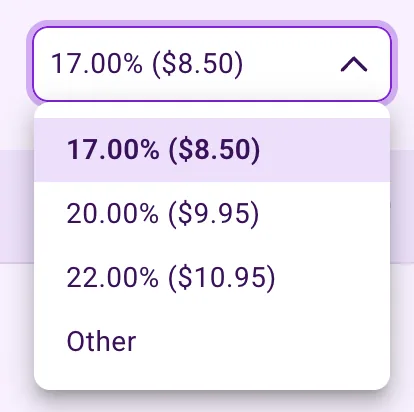
Zeffy relies entirely on donor contributions suggested at checkout. The defaults are the main practical difference from GalaBid's model: by Zeffy's own account, suggested contributions start at 17% for smaller transactions and step down as amounts grow, and Zeffy confirms organisations cannot customise or lower these defaults. Donors can edit the amount, including to zero. There is no paid alternative: Zeffy has no plan tiers at all, so if you want a checkout with no contribution ask, Zeffy cannot offer one at any price. None of Zeffy's contribution revenue is shared with fundraisers.
Givebutter enables optional tips by default. When tips are on, Givebutter charges no platform fees, and while donors are still shown the card processing fees at checkout as an optional extra, the Givebutter Guarantee covers whatever donors decline to pay, so the organisation keeps the full donation.
When tips are off, a flat 3% platform fee applies across all campaign types, plus standard processing of 2.9% + 30 cents per card transaction. Worth knowing: turning tips off does not automatically give your donors a clean checkout. Givebutter's default handling asks donors to cover the fees instead, so the tip prompt is replaced by a fee-coverage prompt unless you require donors to pay the fees or absorb them yourself.
In practice, a donor on default settings sees a fee or tip prompt of some kind in every Givebutter mode. By Givebutter's own worked example, a US$100 donation with tips off can become a US$106.30 charge when the donor covers the fees.
On auctions, the free tips-on option is also unavailable if you use auto-charge for winning bids, which forces the platform-fee model. As with any platform on this list, including GalaBid, it is worth running a test transaction to see exactly what your supporters will see at checkout before your campaign goes live.
Across all three platforms, the pattern to check is the same: what percentage is suggested by default, how obvious the opt-out is, and whether any of it flows back to your cause. On that last point, GalaBid is the only platform in this comparison that shares tip revenue with fundraisers.
What can each platform actually run?
This is where the three diverge most, and it matters more than fees for most event fundraisers.
GalaBid covers the full campaign toolkit in one place: a silent auction, live auction, raffle, paddle raise, event ticketing and donations can all run in a single campaign, whether that campaign is online only, built around an in-person event, or both.
Where GalaBid pulls ahead of the other two is when there is a room full of people: leaderboards, SMS outbid alerts, table management and event-night check-in are native rather than afterthoughts.
GalaBid also accepts individuals and community groups, not just registered charities, and operates across the US, UK, Canada, Europe, Australia, New Zealand, Singapore and Hong Kong. If you are planning your first event, our guide on how to run a silent auction walks through the whole process.
Zeffy covers donation forms, ticketing, raffles, memberships and a simple auction tool. It is a capable generalist for small organisations, but the auction and event-night features are lighter: it is not built around gala mechanics like paddle raises, table management or in-room leaderboards.
Zeffy is available in the US, Canada, the UK and Australia. In the US it requires registered 501(c)(3) status, while in Canada and Australia organisations with a bank account in the organisation's name can qualify without charity registration (an ABN is required in Australia).
Individuals cannot use Zeffy, as personal bank accounts are not permitted. Australian fundraisers should also note Zeffy's position that it is technology only: your organisation is solely responsible for fundraising compliance, including state registrations and raffle permits, with no local team to guide you through them. For an Australia-specific look at your options, see our guide to fundraising platforms for Australian nonprofits and schools.
Givebutter spans donation forms, fundraising pages, events, auctions, a donor CRM and email and text tools. If you want fundraising and donor management in one system, it is the strongest of the three on breadth. The trade-offs are depth and cost: advanced CRM features such as workflows, custom reports and texting sit in Givebutter Plus, which starts at US$29 per month billed annually and scales with contact count, and reviewers have flagged gaps such as sales tax handling on auctions.
Who holds your money?
This question gets skipped in most comparisons, and it is the one we would ask first.
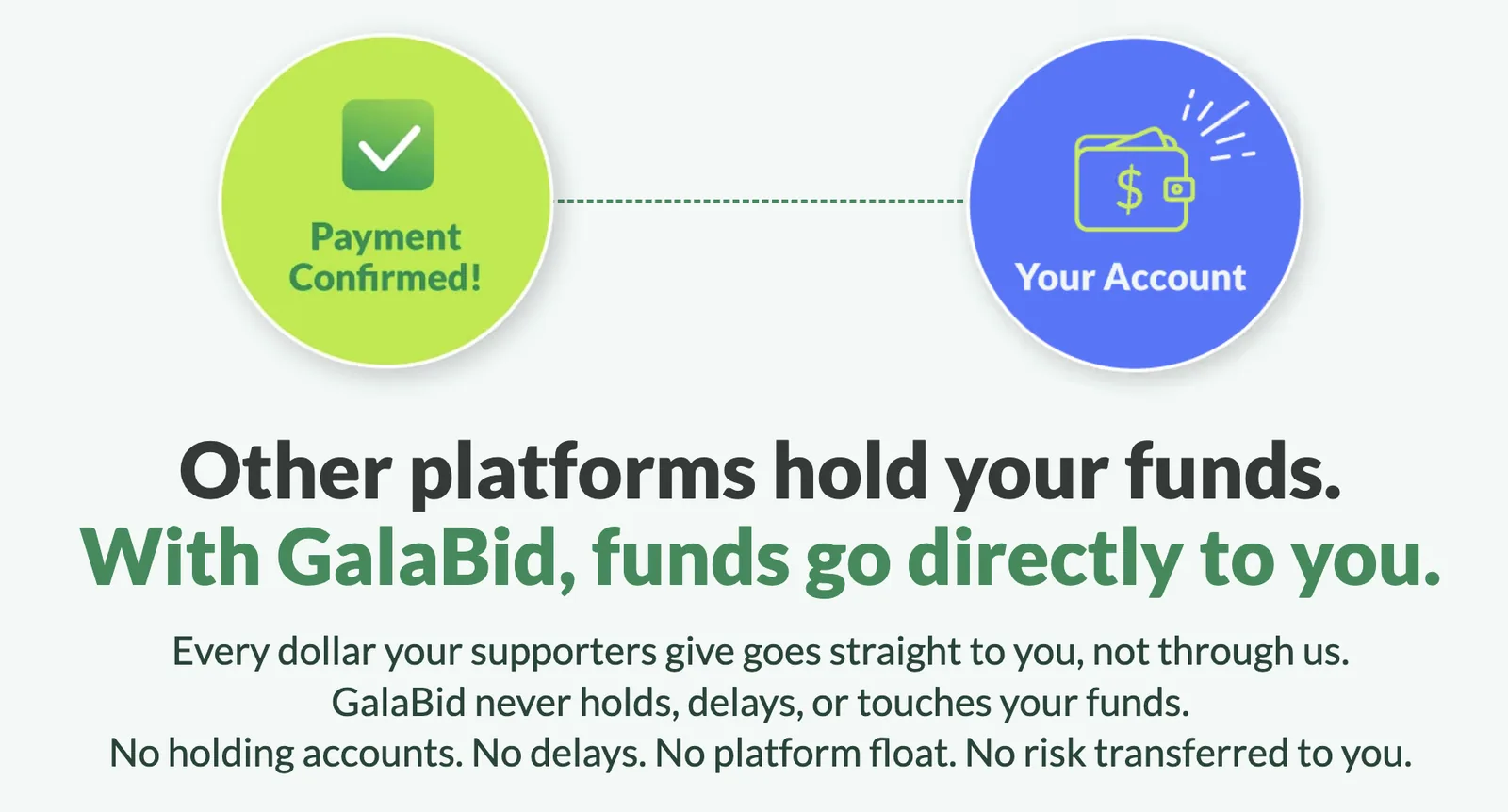
With GalaBid, payments go through a Stripe account that your organisation owns and controls. GalaBid never holds, delays or touches your funds on any plan, and there is no payout schedule because there is no payout: the money settles in your account as supporters pay. Owning the Stripe relationship also means owning the rate. GalaBid does not mark up Stripe's fees, and eligible nonprofits can apply for Stripe's published nonprofit discount of 2.2% + 30 cents per transaction, down from the standard 2.9% + 30 cents. Two honest caveats on that discount: it applies to tax-deductible donations rather than ticket or auction payments, and it requires the majority of your account's volume to be donations. Beyond the published discount, larger organisations can negotiate custom pricing with Stripe directly, which is only possible because the account is yours. On platforms that process payments through their own systems, the processing rate is whatever the platform sets, and there is nothing to negotiate.
With Zeffy, payments are processed through Zeffy's own system and transferred to your bank account on a payout schedule. That works fine for most small nonprofits, but your funds spend time in someone else's system, and access depends on their processes.
With Givebutter, funds flow through the Givebutter Wallet before payout, with direct deposit typically taking two to three business days. Again, workable for most, but it is custody of your money by a third party, and it is worth understanding their verification and hold policies before a large campaign.
If your treasurer asks "where is the money between the donation and our bank account," the three answers are: your own Stripe account (GalaBid), Zeffy's system (Zeffy), and the Givebutter Wallet (Givebutter).
A worked example: a US$10,000 auction
Say your auction raises US$10,000 in winning bids.
- GalaBid Free plan: you receive the full US$10,000, minus Stripe processing on each transaction (absorb it or pass it to winners). Supporters may add tips on top, and GalaBid shares 10% of those tips back with your cause, so your total can exceed US$10,000.
- GalaBid Pro plan: winners see no tip prompts. You receive US$10,000 minus the 4.9% fee and Stripe processing, so roughly US$9,510 before processing.
- Zeffy: you receive the full US$10,000, with donor contributions to Zeffy added to checkout totals by default. Available to eligible organisations in the US, Canada, the UK and Australia. There is no option, free or paid, to remove the contribution ask.
- Givebutter, tips on: you receive the full US$10,000, with tips added at checkout by default and processing covered by the Guarantee where donors decline it.
- Givebutter, tips off: a 3% platform fee plus processing applies, so roughly US$9,700 before processing if you absorb the fees. By default, winners are instead asked to cover the fees at checkout, so the tip prompt becomes a fee prompt. Note that if you auto-charge winning bidders, the free tips-on option is not available at all.
The pattern: "free" on every platform means "your supporters are asked to contribute at checkout." The paid options exist for organisations that would rather absorb a known cost than put that ask in front of their donors, and it is worth checking what your supporters actually see in each paid mode. Of the three, GalaBid Pro is the only option here where winners see nothing but their bid amount unless you choose to pass on processing. Only GalaBid turns the tip model into revenue for your cause rather than just for the software company.
What about support?
For volunteer-run organisations, support quality on event night matters as much as any feature. The three platforms take different approaches.
GalaBid provides support from real fundraising specialists rather than chatbots, via live chat available seven days a week with near round-the-clock coverage across time zones, backed by video tutorials and help guides. Reviewers regularly mention getting help during live events, including late in the evening mid-auction, which is when it counts.
Zeffy offers chat and email support alongside a help centre. Reviews of the support itself are mostly positive, though as a free platform with no paid tiers there is no premium or dedicated support option for event night.
Givebutter advertises 24/7 human support through live chat and email for all users at no cost, plus a help centre, free courses and weekly office hours. Credit where due: for an always-free support offer, it is a strong one.
Which one should you choose?
Choose GalaBid if your fundraising involves auctions, raffles or ticketing in any form, whether that is an online-only campaign, a gala dinner, or a mix of both. It is the strongest of the three on event night, and just as capable when there is no event at all. It is also the only option here if you are an individual or informal group, or if you are fundraising in Europe beyond the UK, New Zealand, Singapore or Hong Kong, where the other two do not operate. And if fund custody matters to your board, direct-to-Stripe settlement is the cleanest answer available. For a deeper look at how the event features compare across more platforms, see our guides to the best silent auction software and the best raffle platforms for US nonprofits.
Choose Zeffy if you are an eligible organisation in the US, Canada, the UK or Australia running mostly donation forms and simple campaigns, you are comfortable with a contribution ask that is added to your donors' checkout by default and cannot be switched off, and event-night mechanics are not a priority. For a closer head-to-head, we have a full GalaBid vs Zeffy comparison.
Choose Givebutter if your priority is an all-in-one system with donor management, you fundraise year-round rather than event-to-event, and you are happy either with the tip-on default or budgeting the 3% fee. Test the donor checkout experience first.
Frequently asked questions
Is Zeffy really 100% free?
For the organisation, yes: Zeffy charges no platform or processing fees, and there are no paid tiers. The platform is funded by contributions donors are asked to make at checkout, added to the suggested total by default. Because there is no paid plan, there is no way to give your donors a checkout without that ask. Whether that counts as free depends on whether you consider your donors' checkout experience part of the cost.
What does Givebutter charge in 2026?
Under Givebutter's current standard pricing, campaigns with tips enabled pay no platform fees and the Givebutter Guarantee covers processing. With tips disabled, a flat 3% platform fee applies plus processing of 2.9% + 30 cents per card transaction. Accounts created before September 2025 may remain on legacy pricing with fees of 1% to 5% by campaign type.
Can individuals use these platforms?
GalaBid accepts individuals and community groups as well as registered nonprofits. Zeffy requires an organisation with a bank account in its own name, so individuals cannot use it. Givebutter primarily serves organisations. If you are fundraising personally, see our guide to fundraising platforms for individuals.
Which platform pays out fastest?
GalaBid does not pay out at all in the traditional sense: funds settle directly in your own Stripe account as payments happen. Zeffy and Givebutter both process funds through their own systems and transfer to your bank on their payout schedules.
Can nonprofits get cheaper card processing?
On GalaBid, yes, because the Stripe account is yours. Eligible nonprofits can apply to Stripe for its published nonprofit rate of 2.2% + 30 cents per transaction on donation volume, and GalaBid never marks up Stripe's fees on any plan. High-volume organisations can also negotiate custom Stripe pricing directly. On Givebutter, processing runs at their published rates through their system, and on Zeffy processing is absorbed by the platform, so there is no rate for your organisation to improve on either.
Do these prices apply everywhere?
The figures above are the published US pricing. GalaBid customers in Australia, New Zealand, Singapore and Ireland work with a local team on pricing tailored to their event, so if you are in one of those regions.