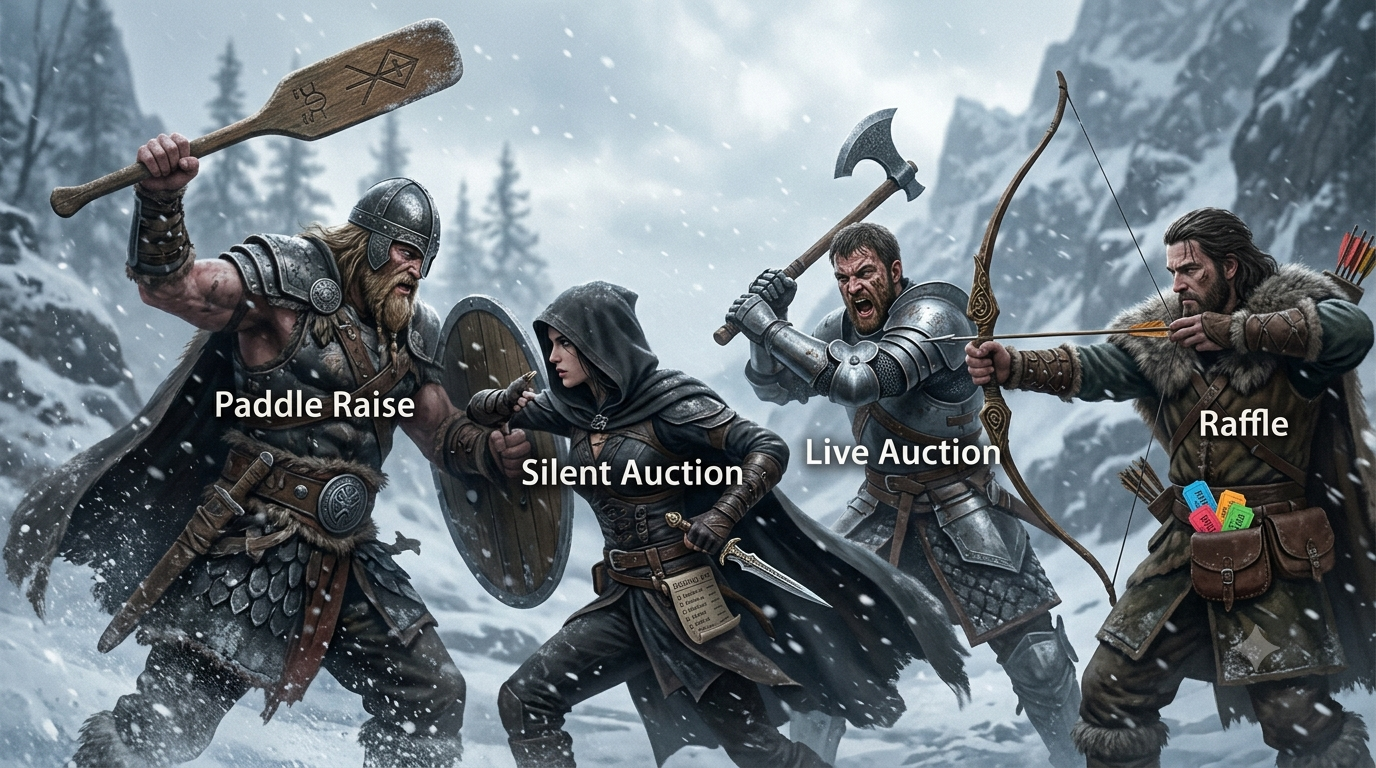
If you are planning a fundraising gala, charity dinner, or benefit event, you have probably asked yourself this question:
Should we do an auction? A raffle? A paddle raise? All four? And if all four, which one actually moves the needle most?
The honest answer is that each of these fundraising activities works differently, draws on different dynamics in the room, and suits different types of events and audiences. Understanding what makes each one tick, and how they complement each other, is far more useful than declaring a single winner.
This guide breaks down how each format works, what drives revenue in each case, and how to think about combining them for a night that fires on all cylinders.
The Four Formats at a Glance
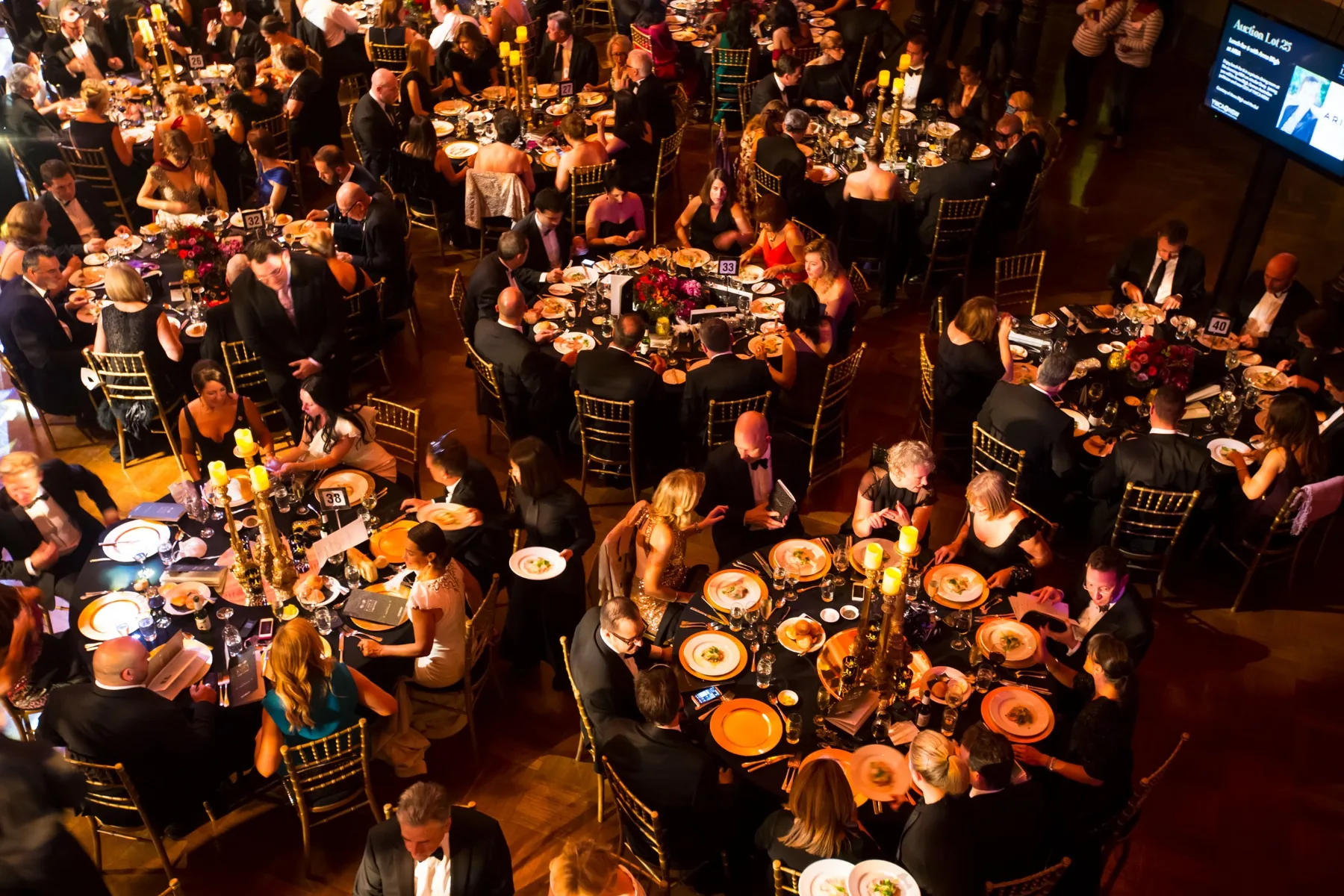
The Silent Auction: Your Longest Revenue Window
How it works
A silent auction runs in the background of your event. Items are listed on a digital platform like GalaBid and guests bid from their phones throughout the evening, from the moment they arrive through to dinner and beyond. There is no auctioneer, no single dramatic moment, just sustained competitive bidding that builds quietly and then closes in a rush.
The silent auction is typically the highest-volume fundraising activity at most gala events in terms of total transactions. More people participate in it than any other format, because the entry point is accessible, the process is low-pressure, and guests can engage with it at their own pace.
What drives revenue
The quality and variety of your items is the single biggest lever in a silent auction. Unique experiences, travel packages, exclusive access, and items with real desirability will consistently outperform generic prizes. A catalogue that offers something for everyone, from items with starting bids of $50 through to premium packages worth thousands, keeps more guests actively bidding rather than sitting on the sidelines.
The length of your bidding window matters too. A silent auction that opens pre-event and runs through dinner gives guests far more time to engage than one that only opens on the night. GalaBid's platform lets you start accepting bids days or even weeks before your event, and up to 40% of total campaign revenue can come in before the night itself.
Competition is the engine. When guests receive outbid notifications by SMS and can see live bidding activity on screen, they bid higher. GalaBid's mobile bidding platform keeps this loop running automatically, with real-time outbid alerts and live leaderboard displays on your event screens that keep the competitive atmosphere alive even when guests are away from their phones.
What it does not do
A silent auction does not create a single shared moment in the room. While it generates excellent revenue across a long window, the energy is distributed rather than concentrated. You will not get the collective surge of generosity that a well-executed paddle raise or the theatre of a live auction can produce. That is not a flaw, it is just a characteristic of the format. It means the silent auction works best as the backbone of your evening rather than its emotional centrepiece.
Typical revenue contribution
At most events, the silent auction is the largest single revenue source, often accounting for 40 to 60% of the night's total fundraising depending on the quality of the catalogue and the size of the room.
The Live Auction: Your High-Value Showpiece
How it works
A live auction is a traditional auctioneer-led event where a small selection of premium items are sold one at a time to a room of bidders. Guests raise their hands or paddles to accept each bid increment, and the item goes to the highest bidder when the hammer falls. Unlike the silent auction, which runs across dozens of items simultaneously, the live auction concentrates the entire room's attention on a single item at a time.
On GalaBid, live auction items can be showcased in your campaign in advance, with an optional pre-bidding window that gives you a head start on price and tells your auctioneer which guests have already shown interest. Once the live auction begins, winning bids are entered by a volunteer using GalaBid's platform and added directly to the winner's invoice. Payment can then be taken immediately by a volunteer or admin on the night, or winners can pay themselves via a mobile payment link as soon as the auction closes.
What drives revenue
The live auction lives and dies on the quality of its items. Because only a handful of lots are typically featured, usually four to eight, each one needs to excite the room. One-of-a-kind experiences, luxury travel, exclusive access, and high-value packages that cannot easily be purchased elsewhere tend to perform best. These are items that people will compete fiercely to win because they cannot simply buy them anywhere else.
A skilled auctioneer is equally important. A professional benefit auctioneer knows how to read a room, build tension between bids, identify the serious bidders, and keep the energy high across multiple lots. The difference between a competent auctioneer and a great one can be tens of thousands of dollars in a single evening. GalaBid can connect organisations with professional auctioneers if needed.
Pre-bidding also plays a useful role. GalaBid's pre-bid feature lets guests place bids on live auction items before the event, giving the auctioneer a clear picture of interest and a floor price to start from on the night. It can also drive competitive awareness in the room when guests know others have already been bidding.
The live auction also benefits significantly from good production. A scrolling leaderboard showcasing each item and current bid activity, countdown timers, and strong visuals on your event screens all amplify the drama and keep the room engaged between lots.
What it does not do
The live auction is not for everyone in the room. By definition, it produces only one winner per item, which means the majority of guests are spectators for most of the evening's live auction programme. If your guest list includes a broad mix of financial capacities, the live auction can feel exclusionary for those who cannot comfortably bid at the levels the items command.
It also requires more production than any other format on this list. You need an auctioneer, a clear run-of-show, volunteer spotters to identify bidders, and a room that is settled and paying attention. Done poorly, it can drag and lose the room's energy rather than build it.
Typical revenue contribution
At galas where the conditions are right, the live auction often contributes 20 to 35% of total fundraising revenue, heavily weighted toward the top few items in the catalogue. The concentration of value in a small number of lots is both its strength and its limitation.
The Paddle Raise: Your Highest Revenue Per Minute
How it works
A paddle raise, sometimes called a fund-a-need or special appeal, is a live donation moment where your MC or auctioneer calls out giving levels in descending order, typically starting at a high amount like $5,000 or $10,000 and working down to $100 or $50, and guests raise their paddles or hands to commit a gift at each level. Unlike an auction, no one wins anything. It is a direct donation tied to a specific cause, programme, or need.
It typically lasts 8 to 12 minutes. In that window, a well-run paddle raise can generate more revenue than hours of silent auction bidding. Some organisations raise $50,000, $100,000, or more in a single paddle raise moment.
What drives revenue
Emotional connection is everything. The paddle raise works because it follows a moment of real impact: a video that shows who your organisation helps, a beneficiary speaking from the stage, or a story told by your MC that puts a human face on the cause. When guests feel moved and a clear, specific ask follows immediately, generosity flows.
The specificity of the ask matters enormously. "Help us fund our scholarship programme" is weaker than "Tonight, your gift of $500 sends one student to camp for the summer." Tying each giving level to a concrete outcome makes the decision feel meaningful rather than abstract.
Your giving levels need to match the financial profile of your room. A table of corporate sponsors can sustain higher opening levels than a community organisation's supporter base. Starting your levels in the right range means more paddles go up at the top, which signals momentum to everyone watching.
Volunteers play a critical role in capturing every pledge accurately. GalaBid's Volunteer Accounts allow event staff to record each paddle raise commitment against a guest's account in real time, adding it directly to their invoice. The leaderboard thermometer on your event screens rises visibly as each pledge is captured, creating a feedback loop that encourages further giving.
What it does not do
A paddle raise requires the right conditions. It depends on an emotionally engaged room, a skilled MC who can read the energy and hold the moment, and careful sequencing in your programme so it lands at the peak of the evening rather than when guests are tired or distracted. Dropped in at the wrong moment or delivered without enough emotional setup, it underperforms.
It also only happens once. Unlike the silent auction, which generates revenue across the whole evening, the paddle raise is a concentrated burst. If it does not land, there is no second chance.
Typical revenue contribution
When run well, the paddle raise often becomes the single most productive 10 minutes of the entire night. Some event professionals report that well-run paddle raises regularly match or exceed silent auction revenue at galas where the cause has a strong emotional story and the room is full of committed supporters.
The Raffle: Your Broadest Participation Tool
How it works
A raffle sells numbered tickets for a chance to win prizes, with winners drawn at random. On GalaBid, tickets are sold digitally, guests receive their ticket numbers instantly by email or SMS, and the draw is conducted through a certified random number generator. The draw itself is projected live on your event screen through GalaBid's Raffle Projector Display, revealing each winner's name and ticket number in real time as their ticket is pulled.
The raffle is unique among your fundraising activities because it is accessible to virtually every guest in the room. You do not need to outbid anyone. You do not need to feel moved enough to make a major gift. You just buy a ticket, or a bundle of tickets, and wait to see your name on the screen.
What drives revenue
Ticket pricing and bundle structure have the biggest impact on raffle revenue. Offering bundles, for example one ticket for $20 or six tickets for $100, consistently increases the average spend per person compared to single-ticket pricing alone. Guests who intend to spend $20 will often spend $100 if the bundle feels like value.
Your volunteers are a major driver here too. GalaBid's Volunteer Accounts allow event staff to sell raffle tickets directly on behalf of guests, moving from table to table throughout the evening and accepting both card and cash payments on the spot. Every sale is entered into the platform in real time, so nothing is lost to a manual tally sheet at the end of the night.
Pre-event ticket sales add significantly to raffle revenue. Opening your raffle before the event means supporters who cannot attend can still participate, and guests who receive their invitation early can start buying before the night. Revenue that comes in before the event does not depend on how your evening unfolds.
The live draw on a big screen is the raffle's standout moment. A projected draw with the room watching in real time as each winner's name appears creates a shared excitement that paper draws or emailed results simply cannot replicate.
What it does not do
The raffle is unlikely to be the highest revenue generator of the night at most events. Where a paddle raise and auction formats can scale significantly with the right room and conditions, raffle revenue is more predictable and more capped. It is also less emotionally connected to the cause than a paddle raise. Guests are buying the excitement of a potential win rather than making a deliberate investment in your mission.
It also requires compliance checks before you run it. Raffle regulations vary by state and territory, and some jurisdictions require a licence depending on the prize value or the nature of your organisation. Always verify the requirements in your location before opening ticket sales.
Typical revenue contribution
At most events, the raffle contributes 10 to 20% of total fundraising revenue. The real value is often as much in participation as in raw dollars. The raffle draws in guests who might not otherwise open their wallets during an auction or make a gift during the paddle raise, which means it reaches a different layer of your audience.
So Which One Raises the Most?
Here is an honest summary of how each format tends to perform:
- The silent auction typically generates the most total revenue by volume, because it runs the longest, engages the widest audience, and accumulates bids across dozens of items over several hours. It is the reliable backbone of your event's fundraising.
- The live auction generates the highest revenue per item, concentrating competitive energy on a small number of premium lots. It is the showpiece of the evening for guests who want to win something extraordinary, and it can deliver outstanding returns when the items are right and a skilled auctioneer is on stage.
- The paddle raise generates the most revenue per minute by a significant margin, and when the conditions are right, it can match or exceed the silent auction in total dollars raised in a fraction of the time. It is the high-risk, high-reward moment of the night.
- The raffle generates the most in participation, reaching guests who may not bid in the auction or give in the paddle raise. Its revenue contribution is smaller but its role in keeping the whole room engaged is disproportionate to what the numbers suggest.
The real answer to the question is that you should not choose between them. These four formats are not competing with each other. They draw on different motivations, operate at different points in the evening, and generate revenue from different segments of your audience. A gala that runs all four well, with good items, strong volunteer support, a skilled auctioneer, and a platform that ties everything together, will consistently raise more than one that relies on any single format alone.
How They Work Together on the Night
Think about the flow of a well-structured gala evening.
Guests arrive during drinks and the silent auction is already live. They browse on their phones, place early bids, and buy raffle tickets from volunteers circulating the room. The competitive dynamic is set before anyone sits down for dinner.
Through the main course, the silent auction continues. Outbid alerts drive guests back to their phones. The leaderboard on screen shows totals climbing. Volunteers keep working the tables selling raffle tickets to anyone who has not yet bought.
After dinner comes the emotional centrepiece of the evening: a speaker, a video, a story. And then, while the room is still feeling it, the MC leads the paddle raise. The thermometer on screen rises with every pledge. The room gives together.
The live auction follows. The auctioneer takes the room through four to eight high-value lots, one at a time, with the full attention of every guest. Bidders compete. The leaderboard tracks each winning bid. The room watches something unfold that only happens in person.
Dessert is served. The MC builds anticipation for the raffle draw. GalaBid's Raffle Projector Display takes over the big screen. Names appear one by one. The room leans in.
Then the silent auction closes and guests receive their checkout notifications. They pay on their phones before they leave.
Every activity has its place. None of them competes with the others. Each one reaches a different nerve in the room at the right moment.
Running All Four on GalaBid
GalaBid is one of the only fundraising platforms that handles all four of these formats in a single campaign, with no need to switch between tools or reconcile separate payment systems.
Your silent auction items, live auction lots, raffle, paddle raise, and donations all live in the same place. Guests register once and their payment details carry across all activities. Volunteer Accounts give your team the ability to sell raffle tickets, record paddle raise pledges, enter live auction winning bids, assist with bidding, and process cash payments from a single device. The leaderboard and raffle display run on your event screens, keeping every moment of the evening visual and engaging.
All funds go directly into your connected Stripe account as payments come in, with no holdbacks and no intermediary.
You can explore all four features and see how they work together at galabid.com, or access a live demo campaign to see the platform in action before your event. If you want to talk through how to structure your event programme to get the most out of each format, the GalaBid team is available via live chat, WhatsApp, and bookable calls.