Raffles are one of the simplest, highest-margin fundraisers a nonprofit can run. Low upfront cost, easy to promote, and they work just as well for a five-person school club as for a national charity. So when you search for free raffle software, the promise is obvious: keep every dollar, pay nothing, raise more.
The reality is a little more interesting. Almost no fundraising platform is genuinely "free" in the way a free app is free. Someone still has to pay for the servers, the payment security, the support team, and the development. The question isn't whether you pay. It's who pays, how visibly, and what it does to your fundraising total.
This guide explains how "free" raffle software actually works, compares the leading platforms in 2026, and covers one factor most comparison articles miss entirely: tipping doesn't behave the same way in every country, which matters enormously if your supporters aren't all American.
What "free raffle software" actually means
When a raffle platform advertises $0 platform fees, it's almost always running one of two models:
1. The donor-tipping model. The software is free for your organisation. At checkout, the donor is asked to add an optional "tip" to support the platform, typically defaulted somewhere between 10% and 19% of their purchase. If enough donors tip, the platform covers its costs and you pay nothing. This is how Zeffy, BetterWorld, Givebutter, RallyUp, Eventgroove and the free tier of GalaBid all work.
2. The percentage platform fee. The software takes a fixed cut of what you raise, commonly around 5%, on top of payment processing. No tip prompt, but the cost scales with your success. A 5% fee on a $20,000 raffle is $1,000, which can quietly exceed a year of paid software.
On top of either model, you'll almost always pay payment processing fees, usually Stripe's roughly 2.9% + $0.30 per transaction. Any platform claiming "completely free" is either covering those fees out of tips or quietly passing them on. There's no such thing as a free transaction; there's only a question of where the cost is parked.
The honest summary: "Free" raffle software shifts the cost from your organisation to your donors. Whether that's a good trade depends entirely on how your donors feel about being asked.
The tip-based model: the upside and the catch
The donor-tipping model is genuinely clever. For a small fundraiser with an engaged, mission-aligned audience, it can mean keeping close to 100% of proceeds. If you're running a $1,200 school raffle to a tight-knit parent community, a tip-funded free platform is hard to beat.
But there's a catch, and it shows up at the worst possible moment: checkout.
A tip prompt appears at the exact instant a supporter has decided to give, and then adds an unexpected ask on top. The effects are well documented:
- Tipping fatigue is real and rising. Payment screens now ask for tips at coffee counters, bakeries and self-checkouts. Surveys have found a large share of consumers feel tipping has gotten out of control. By the time someone reaches your raffle checkout, they may already be primed to resent the prompt.
- High default tips can feel like a trick. When the default tip is set to 15% or 19% and the option to lower or remove it is buried, donors can feel the platform is leaning on their goodwill. That impression rubs off on your organisation, not just the software.
- Friction costs conversions. Every extra decision at checkout is a chance for someone to abandon the purchase. For a small fundraiser the lost ticket sales may be trivial. For a large raffle with hundreds of buyers, even a small drop in completion rate can outweigh any fee you "saved."
None of this makes tipping bad. It makes it conditional: great for some audiences, quietly costly for others. Which brings us to the factor almost no one talks about.
Why tipping doesn't travel: a country-by-country reality check
Here's the part most "best free raffle software" articles ignore entirely: the donor-tip model was built around American tipping culture, and tipping culture is not universal.
Researchers have studied this for decades. Tipping prevalence tracks closely with how individualist a culture is. On Hofstede's individualism index, the three big tipping nations score almost identically at the top: the US (91), Australia (90) and the UK (89). But that shared score hides an important nuance. High individualism doesn't mean identical tipping behaviour:
- United States. Tipping is deeply embedded and expected across an ever-widening range of situations. A donor-tip prompt feels familiar. This is the home turf of the free-with-tips model, and it's where it performs best.
- United Kingdom. Tipping is far more reserved. A discretionary service charge is often added automatically, and many Brits actively dislike being prompted to tip. Surveys show a meaningful share are sceptical that digital tips even reach the right place.
- Australia and New Zealand. The cultural default is a flat price that's simply paid in full, with the firm expectation that businesses, not customers, cover staff wages. An optional "tip to support the platform" can read as faintly off, precisely because the local instinct is "tell me the price and I'll pay it."
- Continental Europe. Tipping is appreciated rather than expected, and in the Nordics service is usually built into the bill. A standalone tip prompt is unfamiliar territory.
Why this matters for your raffle: if you're a US nonprofit raffling to US supporters, a tip-funded free platform is well matched to your audience. But if you're a UK school, an Australian sports club, a Canadian foundation, or any organisation with international supporters, a tip-only model is quietly fighting your donors' instincts. The "free" platform may be costing you completed sales you never see, and you can't fix what you can't measure.
The takeaway isn't avoid tipping. It's choose a platform that lets you choose how it gets paid, so your checkout matches your audience instead of an American default.
Free raffle software compared (2026)
Here's how the main options stack up. All figures are typical at time of writing; always confirm current pricing and check whether processing fees are included.
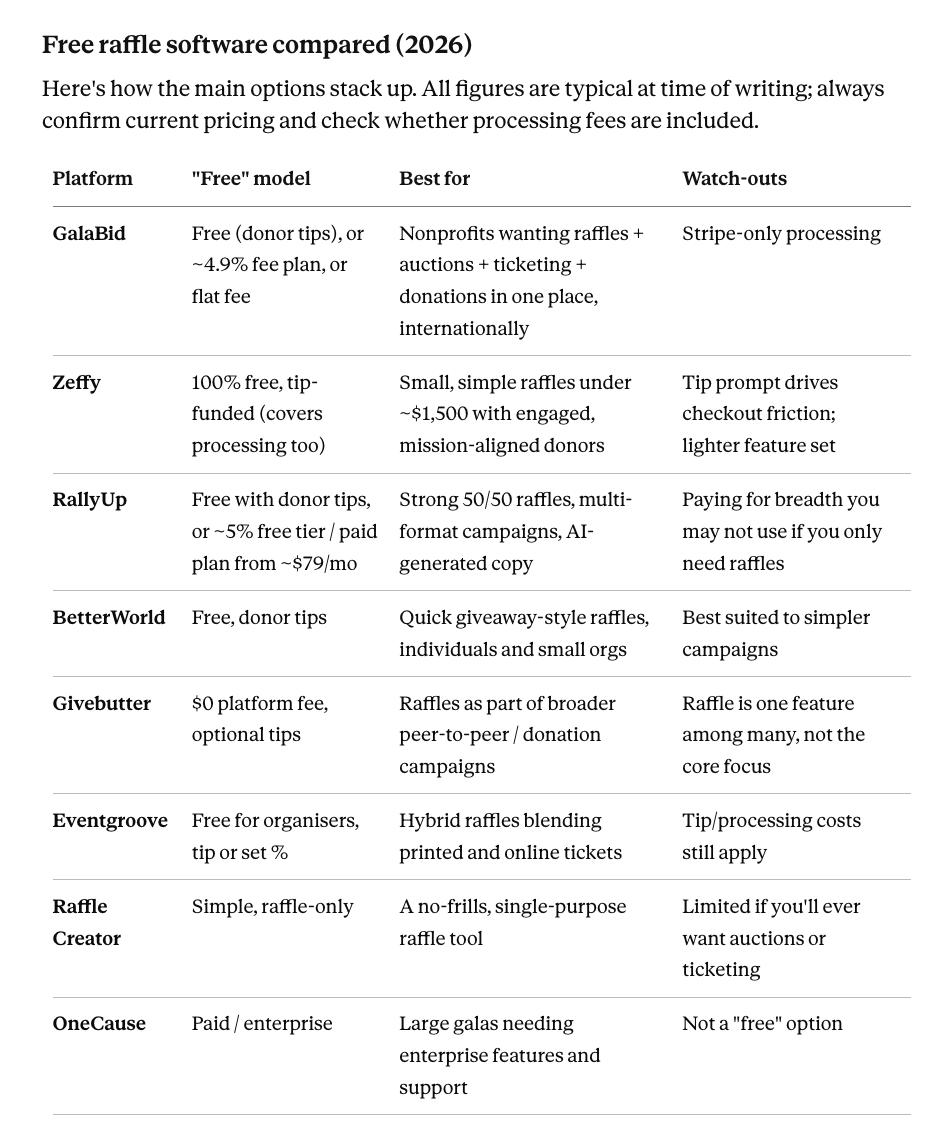
The pattern is clear: most free raffle tools are either tip-only (great for the right small US-leaning audience) or single-purpose (fine until your fundraising grows). The differentiator worth looking for is flexibility, and that's where the platform you choose should earn its place.
Where GalaBid fits
We build GalaBid as a fundraising platform first and a raffle tool second, because most organisations that run a raffle this quarter will run an auction, sell event tickets, or take straight donations next quarter. Here's how that shapes the offer:
You choose how the platform gets paid. GalaBid offers three pricing approaches rather than locking you into one:
- A free, donor-tip plan, ideal where your audience is comfortable with tipping (hello, US supporters).
- A flat ~4.9% platform-fee plan with no tip prompt, a clean, frictionless checkout for audiences in markets like Australia and the UK where "just tell me the price" is the cultural norm.
- A fixed flat-fee plan for larger or higher-volume campaigns where a set cost is more predictable than a percentage.
That choice is the whole point of this article. Instead of forcing an American tipping default onto every donor, you match the checkout to who's actually buying tickets.
Raffles that don't live alone. Tickets sell mobile-first with Apple Pay, Google Pay, and card; winners are drawn with certified random selection and a visible, transparent draw; and the same platform runs your silent auctions, event ticketing and donation pages, so you're not stitching three tools together at gala time.
Built for international fundraising. GalaBid runs across Australia, New Zealand, the UK, the US, Canada and the EU, which is exactly why flexible, tip-optional pricing matters rather than being an afterthought.
The honest positioning: if you're a small US org with a devoted donor base, several tip-funded free tools (including our own free plan) will serve you well. If you want a platform that scales with your fundraising, works cleanly across countries, and lets you decide who pays and how, that's where GalaBid is the stronger long-term home.
A quick word on raffle legality
Raffle software handles the tech; it doesn't handle the law. Raffle rules vary widely by country, and in the US often by state, county and even city. Many jurisdictions restrict who can run a paid raffle (frequently registered charities only), require permits or licences, and limit how tickets can be sold across borders. Online sales add another layer, since a "national" online raffle can cross into jurisdictions with different rules.
No platform, including GalaBid, can give you legal advice, and you shouldn't rely on one that claims to. Before you launch, check your local raffle regulations or consult a professional. Good software keeps you organised and compliant in operation; the legal eligibility is on you.
How to choose: a 30-second checklist
Pick the platform that fits these answers, not the one with the loudest "free":
- Where are your donors? US and comfortable with tipping? A tip-funded free plan is fine. UK, Australia, NZ, Europe, or mixed/international? Favour a fee or flat-rate option with no tip prompt.
- How big is the raffle? Under ~$1,500? The free/tip model usually wins. Several thousand and up? Run the math; a percentage fee or a fixed flat fee may beat tip-driven friction.
- Will you run more than raffles? If auctions, ticketing or donations are anywhere in your future, choose an all-in-one platform now rather than migrating later.
- Does checkout feel clean? Test it on your phone. Count the taps. Friction is the silent killer of ticket sales.
- Can you control how the platform is paid? The most future-proof answer is a platform that lets you switch between tipping, a percentage, or a flat fee as your audience and event size change.
Frequently asked questions
Is raffle software ever truly free?The software can be free to your organisation, but payment processing (typically around 2.9% + $0.30 per transaction via Stripe) almost always applies somewhere. "Free" platforms cover this through optional donor tips or a percentage fee, so the cost is shifted to donors, not eliminated.
Which platforms offer $0 platform fees?GalaBid, Zeffy, BetterWorld, Givebutter and others offer $0-platform-fee options supported by optional donor tips. GalaBid also offers fee-based and flat-fee plans so you can avoid the tip prompt entirely.
What is the donor-tipping model?At checkout, the donor is asked to add an optional tip (often defaulted at 10% to 19%) that goes to the platform instead of a fee charged to your organisation. It can mean keeping nearly 100% of proceeds, but the prompt adds checkout friction, and its success depends heavily on your audience's tipping culture.
Does the tip model work outside the US?Less reliably. Tipping is culturally strong in the US but far more reserved in the UK, and uncommon in Australia, New Zealand and much of Europe, where audiences prefer a clear, all-in price. For international or non-US supporters, a no-tip fee or flat-rate plan often converts better.
Which raffle platform is best for mobile entry?GalaBid is designed mobile-first, so supporters can buy tickets in a few taps on any device, which directly protects your conversion rate.
Which platform combines raffles with auctions and ticketing?GalaBid runs raffles, silent auctions, event ticketing and donations on one platform, so you don't need separate tools for different parts of the same event.
Can I run a 50/50 raffle?Yes. Several platforms (including GalaBid and RallyUp) support 50/50 and split-the-pot style draws. Check your local laws first, as 50/50 raffles are specifically regulated in many areas.
The bottom line
"Free" raffle software is real, but free always means someone else pays, and usually that someone is your donor, at checkout, via a tip. For the right small, US-leaning audience, that's a great deal. For larger raffles, international supporters, or any organisation that will eventually run more than raffles, the smarter choice is a platform that lets you decide how it gets paid (tip, percentage or flat fee) so your checkout fits your fundraiser instead of an American default.
That flexibility, plus mobile-first ticketing and built-in auctions, ticketing and donations, is exactly what GalaBid is built to give you.
Ready to run a raffle that keeps more of every dollar and fits your donors? Start your free GalaBid raffle today.